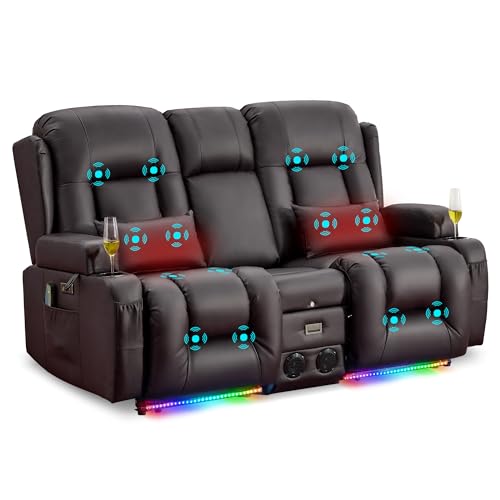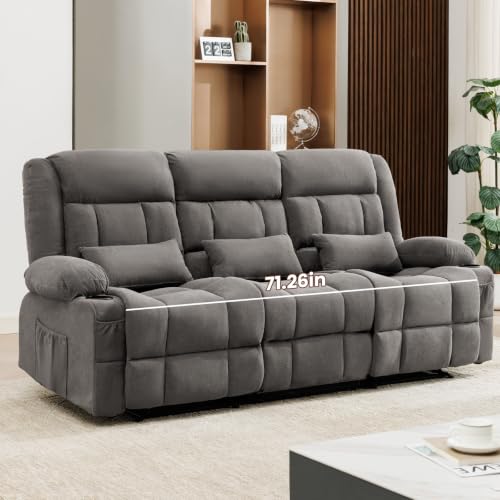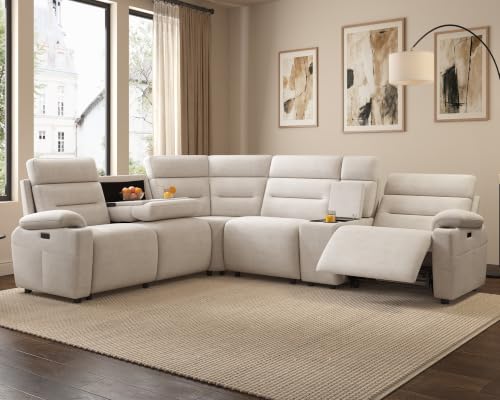
The Complete Guide to Recliner Sofas
Everything you need to know about recliner sofas — from manual and power mechanisms to materials, sizing, and finding the perfect model for your living space
📖 Table of Contents
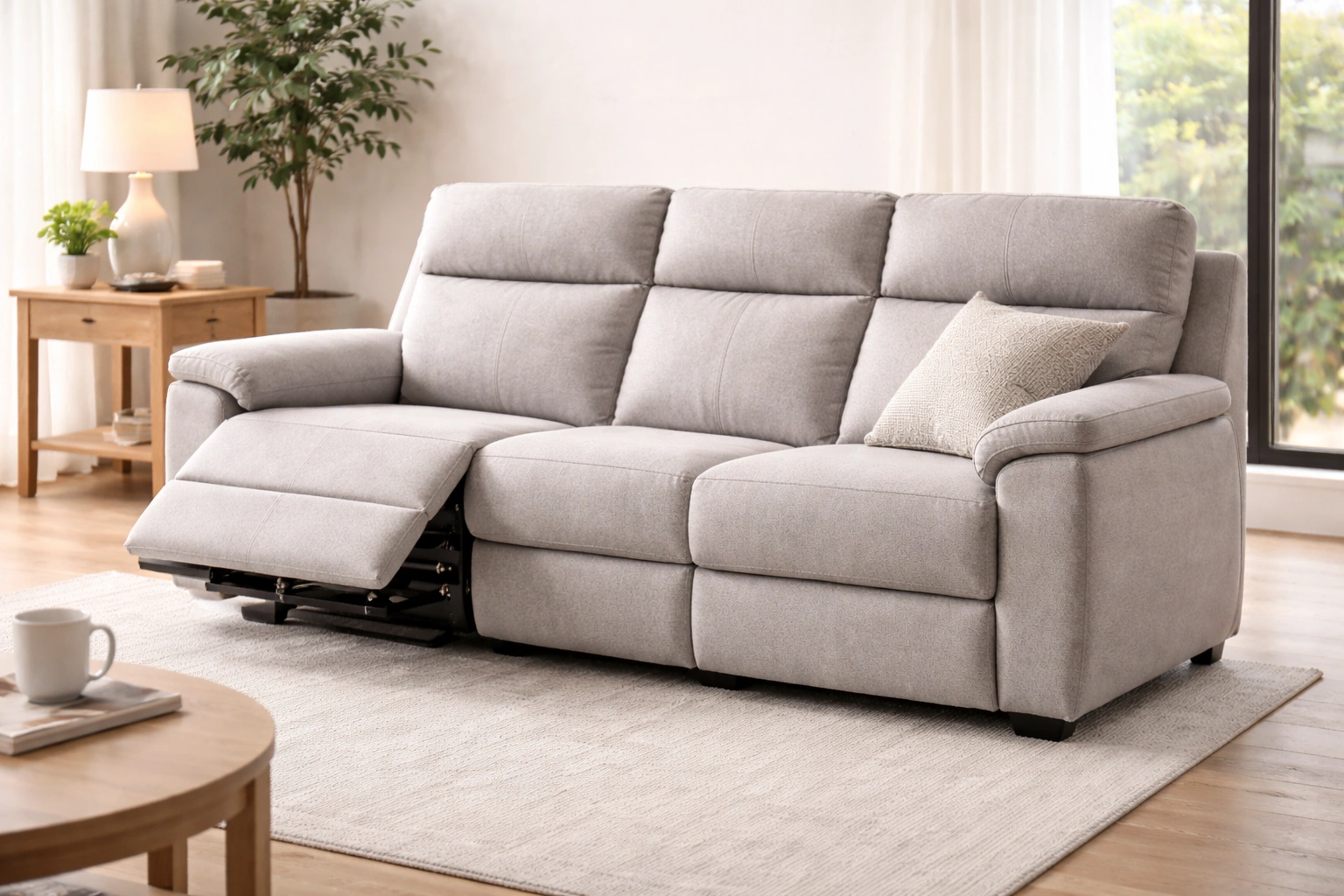
What Is a Recliner Sofa?
A recliner sofa is a seating furniture piece built with an integrated mechanism that allows the backrest to tilt backward and the footrest to extend forward, creating a reclined lounging position. Unlike a standard sofa where you sit upright, a recliner actively supports your body in a semi-horizontal posture — reducing pressure on your spine, improving circulation in your legs, and distributing your weight more evenly across the seat and back.
Originally popularized in the 1920s as single reclining chairs, the concept has evolved dramatically. Today's recliner sofas come in 2-seater, 3-seater, and even sectional configurations, with options ranging from simple manual levers to sophisticated power systems with memory positions, built-in heating, massage functions, and USB charging ports.
What separates a recliner sofa from a comfortable regular sofa is the active adjustability. A regular sofa is static — you adapt your posture to it. A recliner adapts to you, letting you fine-tune the angle for reading, watching TV, napping, or simply relieving back tension after a long day. For anyone dealing with back pain or mobility concerns, a recliner sofa isn't a luxury — it's a practical health investment.
Types of Recliner Sofas
Choosing the right type of recliner sofa is the most important decision you'll make. Each type serves a different purpose, fits different spaces, and offers distinct comfort levels. Here's a detailed breakdown of every major category:
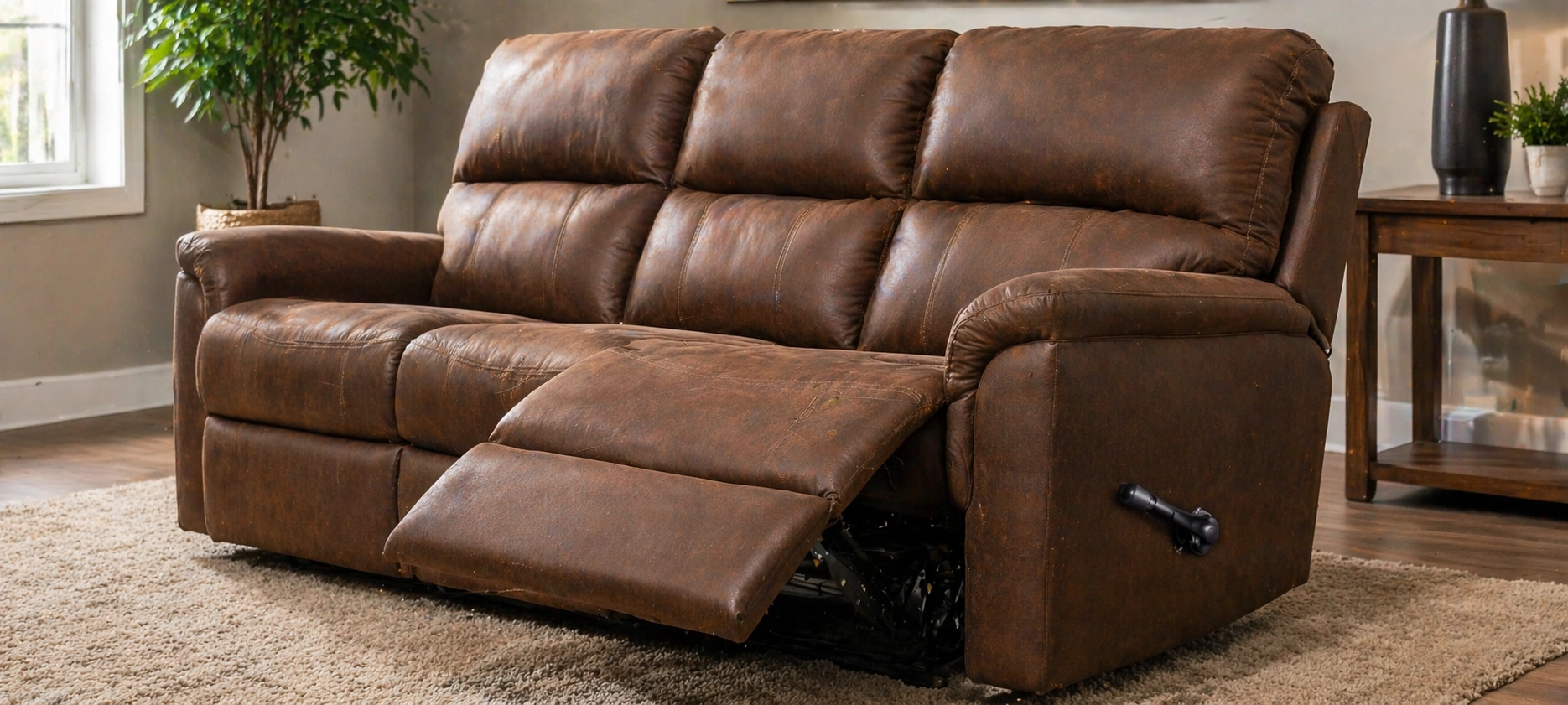
Manual Recliner
Uses a lever or push-back mechanism to recline. No electricity needed — simply pull the lever or push against the backrest. Most affordable option with the fewest components that can malfunction. Ideal for budget-conscious buyers and those who prefer simplicity.
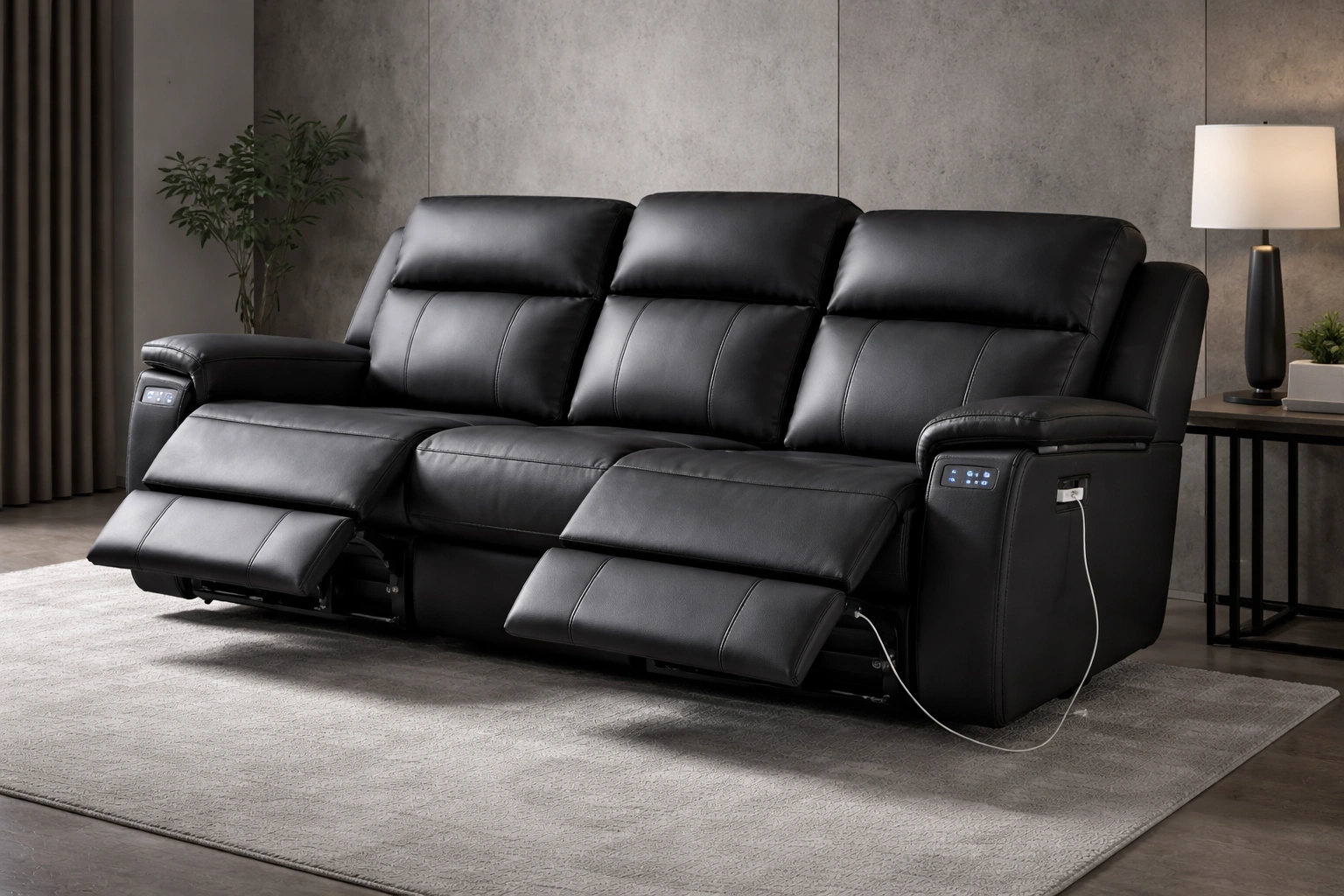
Power Recliner
Electric motor drives the recline motion via button or remote. Offers infinite recline positions, smoother transitions, and often includes independent headrest tilt. Many models feature USB ports and wireless charging. Requires a nearby power outlet.
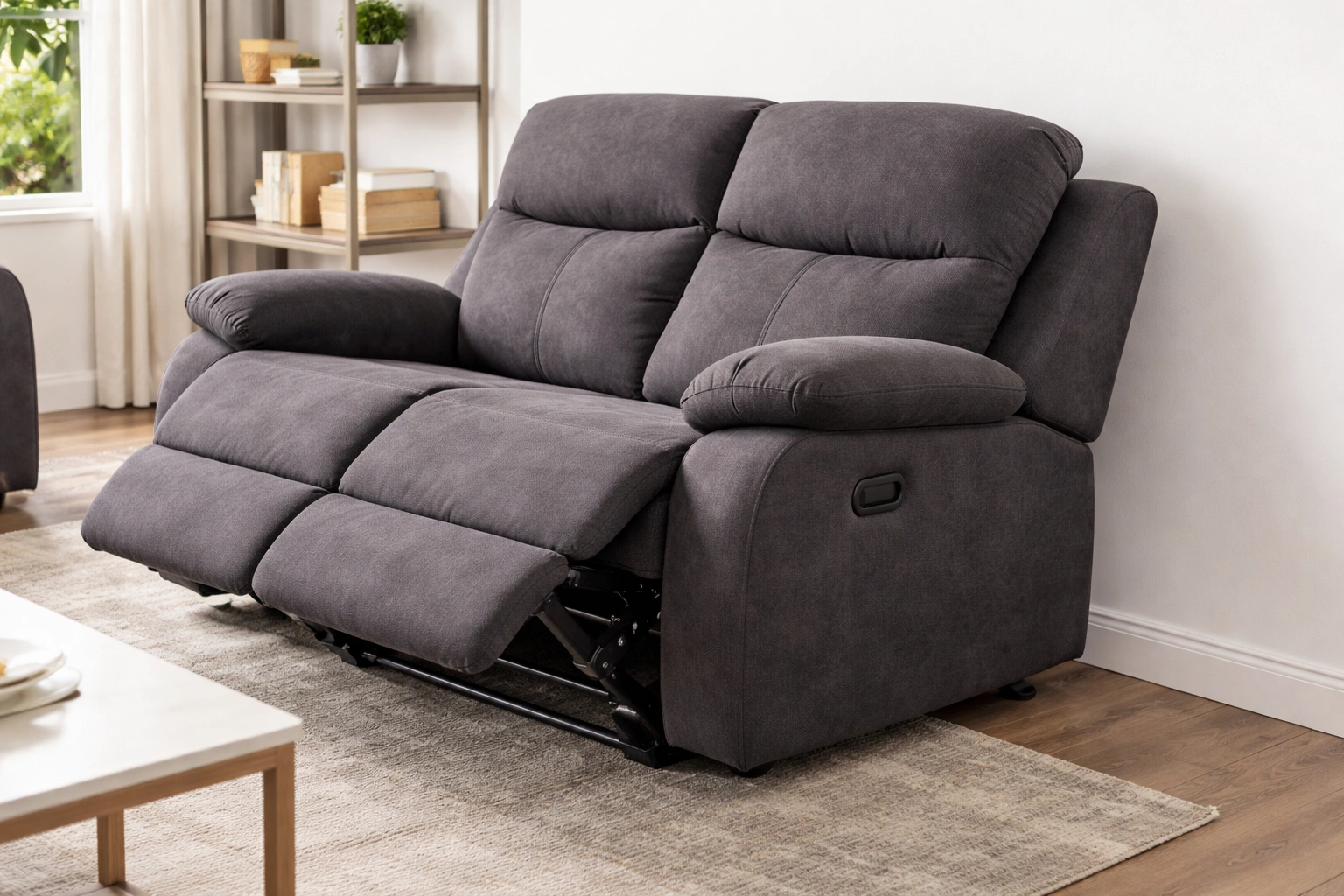
Wall-Hugger Recliner
Engineered to recline forward rather than backward, needing only 3–6 inches of wall clearance. Perfect for small rooms and apartments where space is limited. Available in both manual and power versions.
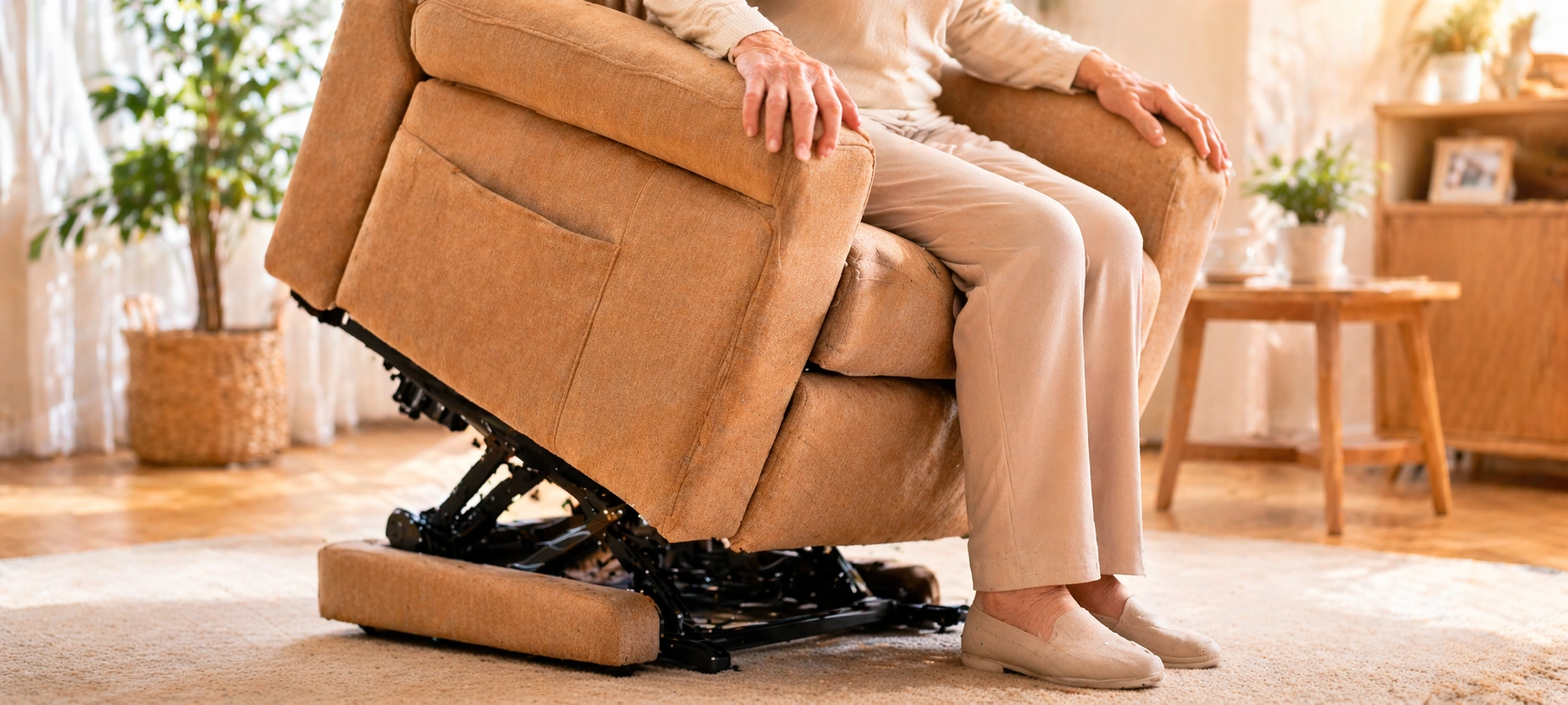
Lift Recliner
Powered mechanism that tilts the entire seat forward to help the user stand up safely. Specifically designed for seniors and individuals with mobility issues. Often includes multiple health-focused positions and heavy-duty motors rated for frequent daily use.
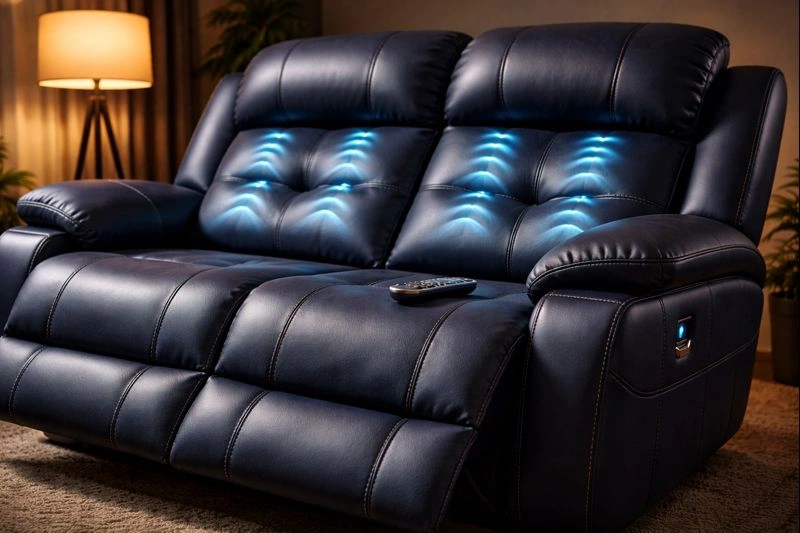
Massage & Heating Recliner
Built-in vibration motors and heating elements in the back and seat. Multiple massage zones, intensity levels, and timed sessions. Heating soothes muscle tension and improves blood flow. Premium option for ultimate relaxation and therapeutic benefits.
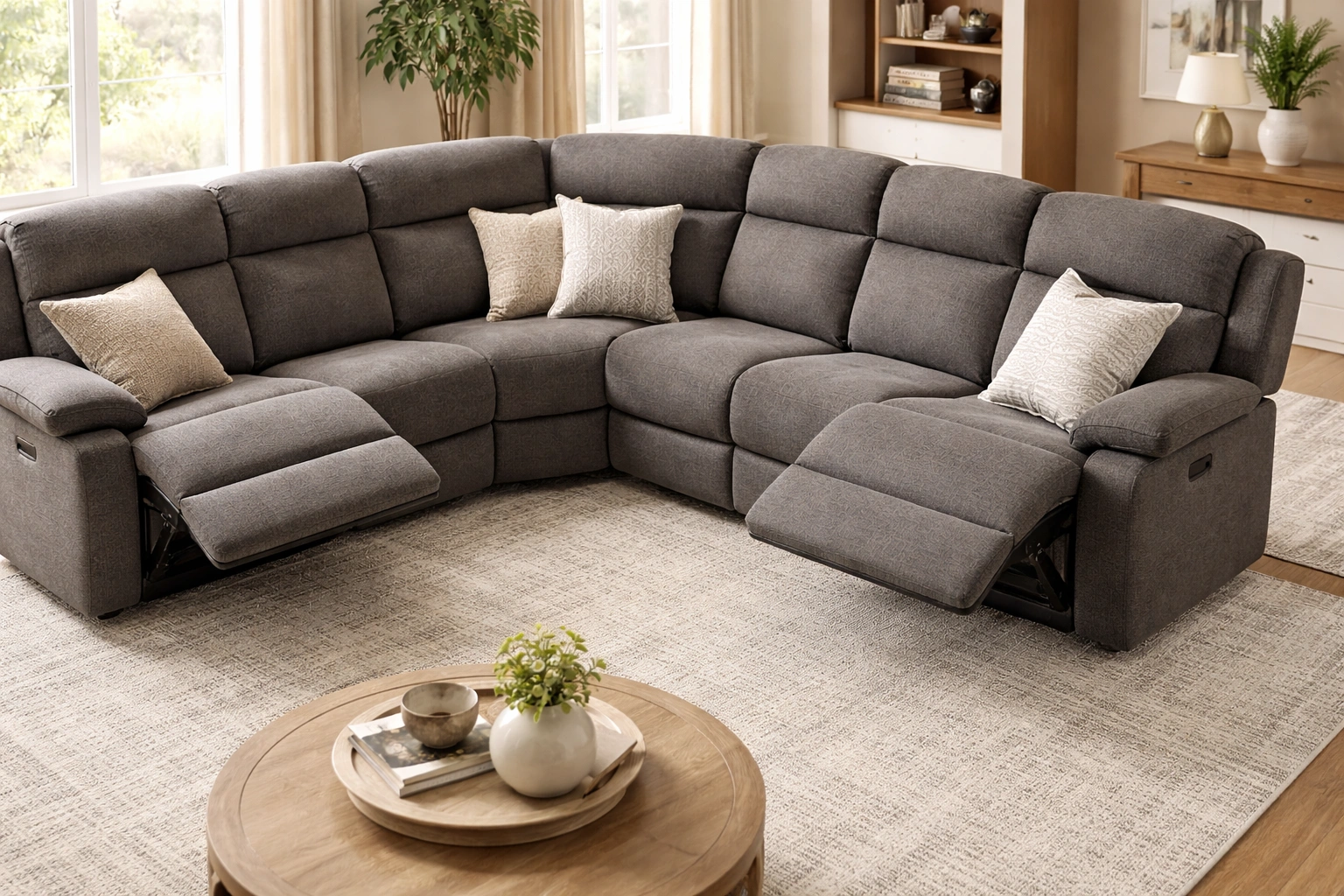
Reclining Sectional
Combines the spacious layout of a sectional sofa with individual reclining seats. Available in L-shape and U-shape configurations. Each seat typically reclines independently. Best for family rooms and large living areas.
How Recliner Mechanisms Work
Understanding the mechanism inside your recliner helps you make a smarter purchase decision and diagnose issues later. There are three primary mechanism types, each with distinct engineering:
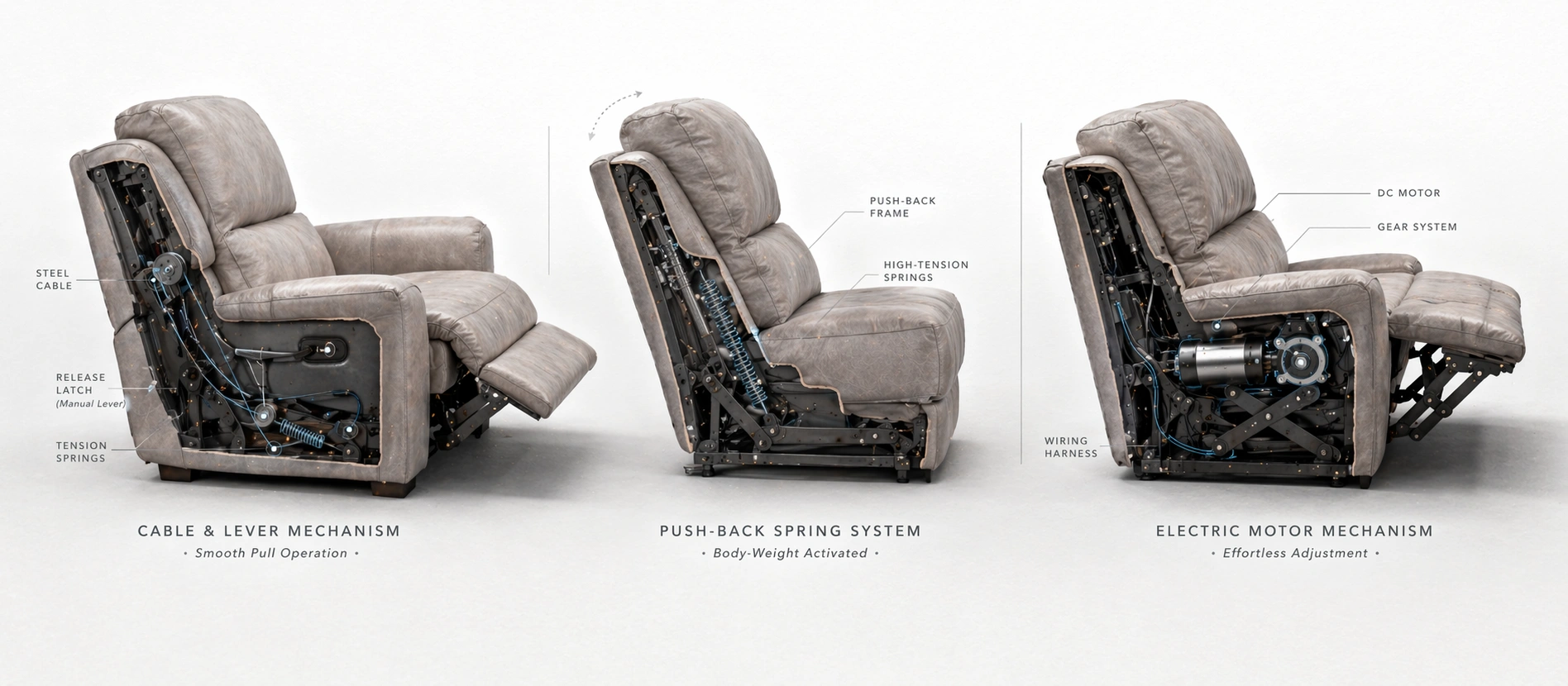
1. Cable-Operated Mechanism (Manual): A steel cable connects the side lever to a release latch inside the frame. Pulling the lever disengages the latch, allowing the spring-loaded footrest to extend and the backrest to pivot. This is the most common manual system — reliable, inexpensive, and easy to repair. The main weak point is the cable itself, which can stretch or snap after years of use but is cheap to replace.
2. Push-Back Mechanism (Manual): No visible lever or button. You simply push your body weight against the backrest while seated, and the recliner opens. A tension spring system holds it in place. To close, lean forward and the mechanism locks back. This system offers the cleanest aesthetic (no levers or buttons) but provides less control over the recline angle — it's typically an all-or-nothing open/close motion.
3. Electric Motor Mechanism (Power): A quiet DC motor drives a scissor-style lift frame through a gear system. Pressing a button sends power to the motor, which smoothly extends the footrest and tilts the backrest. The motor's gear system provides infinite stop positions — you can stop at any angle, not just preset notches. Dual-motor models control the backrest and footrest independently. The mechanism connects to your home's electrical system via a concealed cord, usually routed through the base.
✅ Power Mechanism Advantages
- Infinite recline positions for personalized comfort
- Smoother, quieter operation
- Independent backrest and footrest control (dual motor)
- Easier to operate for people with limited hand strength
- Often includes USB ports, wireless charging, LED lighting
- Memory position settings on premium models
❌ Power Mechanism Disadvantages
- Higher upfront cost ($200–$800 more than manual)
- Requires proximity to a power outlet
- Motor can fail and requires professional repair
- Doesn't work during power outages (unless battery backup)
- Heavier due to motor and internal wiring
- More complex to disassemble for moving
Best Materials for Recliner Sofas
The material you choose affects not just appearance but durability, comfort, and how well the reclining mechanism performs over time. Recliner sofas experience more mechanical stress than standard sofas — the fabric stretches and flexes with every recline cycle — so material choice matters even more here.
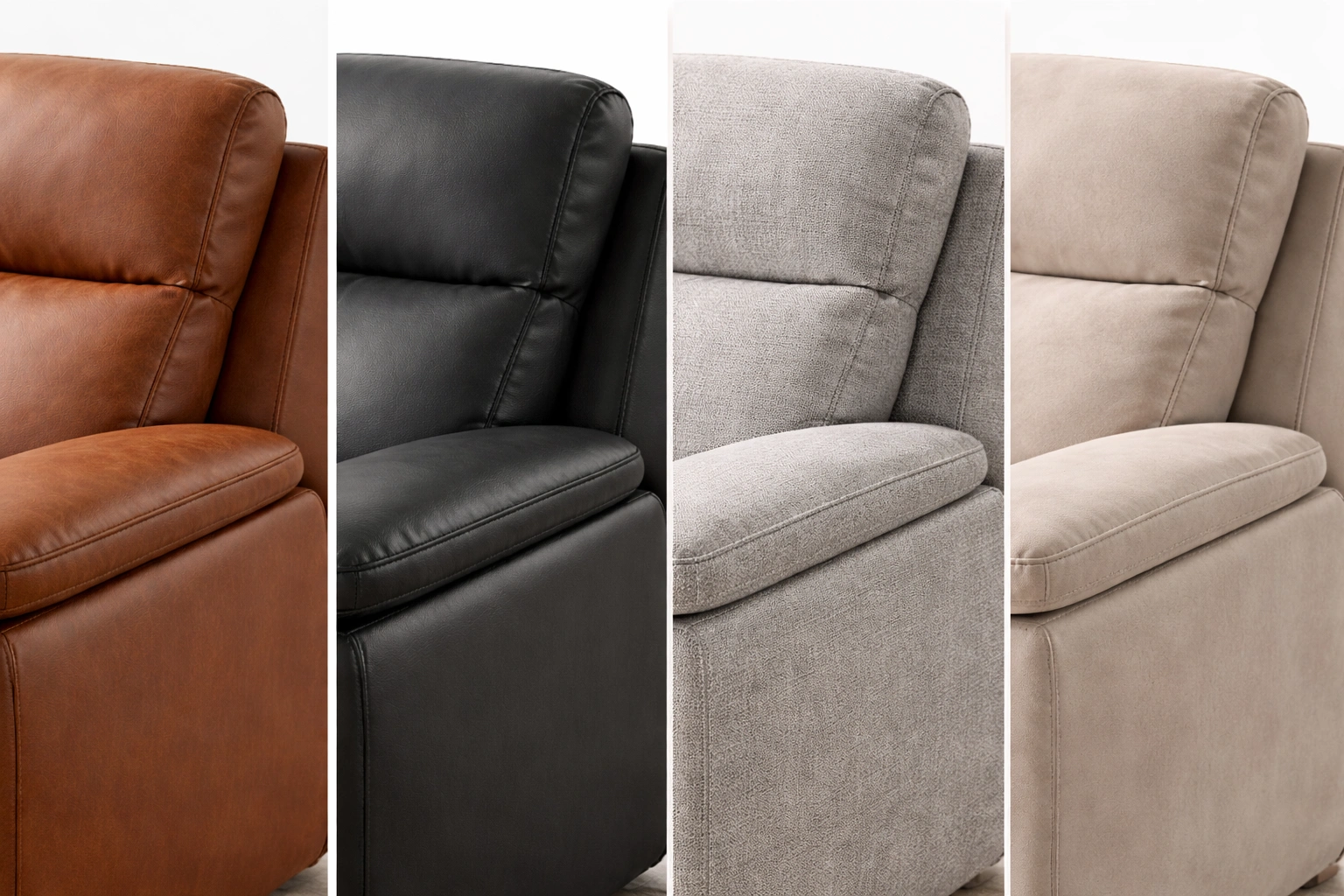
Genuine Leather: The premium choice for recliners. Full-grain and top-grain leather develops a beautiful patina over time and withstands the constant flexing of reclining mechanisms remarkably well. It's easy to wipe clean, resists pet hair clinging, and has a luxurious feel. The downside is cost ($1,500–$5,000+) and temperature sensitivity — it feels cold in winter and sticky in summer unless climate-controlled. For a deeper comparison, see our leather vs. fabric guide and leather grades explained.
Faux Leather (PU/PVC): A budget-friendly alternative that mimics leather's look. Modern high-quality PU leather is surprisingly durable and handles the flexing of recline mechanisms well. However, cheaper PVC-based faux leather can crack and peel at stress points after 2–3 years. If choosing faux leather, opt for PU over PVC and look for a minimum thickness of 1.2mm.
Performance Fabric: Engineered textiles like polyester blends, microfiber, and Crypton fabrics that resist stains, fading, and wear. These are excellent for families with children or pets. Microfiber is particularly popular for recliners because its tight weave handles repeated stretching without pilling. Performance fabrics score high on the Martindale abrasion test (look for 50,000+ cycles).
Bonded Leather: A composite material made from leather scraps bonded with polyurethane. It looks like leather initially but has significantly shorter lifespan — typically 3–5 years before cracking and peeling begins. We generally recommend avoiding bonded leather on recliners due to the added mechanical stress. If budget is tight, a quality fabric recliner will outlast a bonded leather one.
| Material | Durability | Recline Flex Tolerance | Maintenance | Price Range |
|---|---|---|---|---|
| Full-Grain Leather | Excellent (15+ yrs) | Excellent | Conditioning required | $1,800–$5,000+ |
| Top-Grain Leather | Very Good (10–15 yrs) | Very Good | Moderate care | $1,200–$3,500 |
| PU Faux Leather | Good (5–8 yrs) | Good | Easy wipe clean | $500–$1,500 |
| Performance Fabric | Very Good (8–12 yrs) | Excellent | Spot clean | $600–$2,000 |
| Microfiber | Good (6–10 yrs) | Very Good | Easy clean, resists stains | $400–$1,200 |
| Bonded Leather | Poor (3–5 yrs) | Poor — cracks at flex points | Wipe clean (until peeling) | $300–$800 |
For the internal structure, pay attention to the frame materials. Recliner frames face more stress than standard sofas because the reclining motion creates leverage forces. A kiln-dried hardwood frame (oak, maple, or birch) with reinforced corner blocks and steel brackets is strongly recommended. Avoid frames made primarily of particleboard or softwoods like pine for recliners — they won't hold up under repeated mechanical stress.
Size & Space Planning Guide
One of the most common mistakes buyers make is underestimating the space a recliner sofa needs. Unlike a standard sofa, a recliner's dimensions change dramatically when it's in the reclined position. Failing to account for this results in blocked walkways, damaged walls, or a sofa that can't fully open.
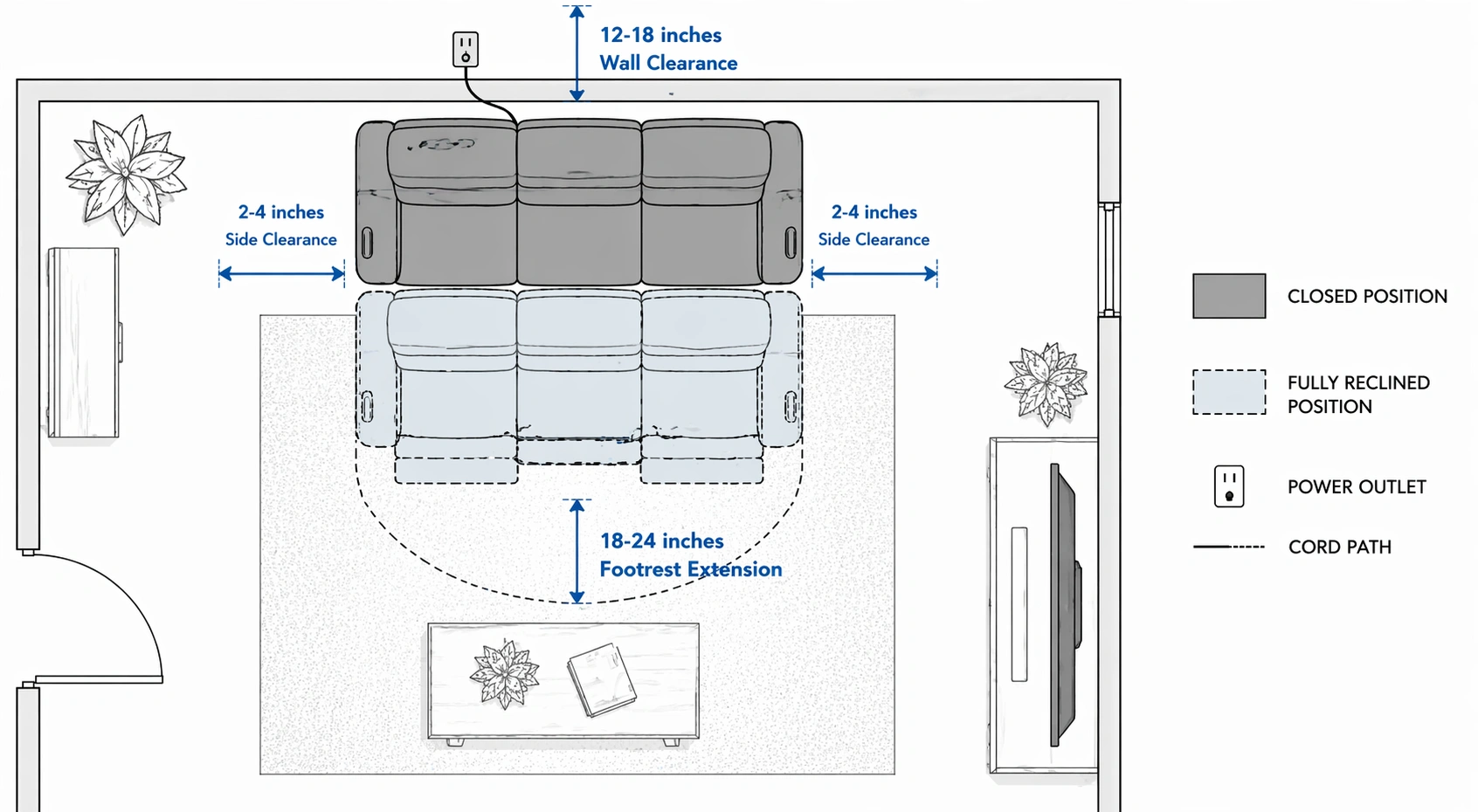
Wall Clearance Requirements:
- Standard recliner: 12–18 inches behind the backrest when fully reclined
- Wall-hugger recliner: 3–6 inches — the seat moves forward as it reclines
- Lift recliner: 18–24 inches to accommodate the forward tilt motion
- Side clearance: Allow 2–4 inches on each side for armrest movement and airflow around motors
Footrest Extension: When the footrest deploys, it extends 18–24 inches beyond the front of the seat. Measure this distance from your sofa's front edge to the nearest coffee table, ottoman, or wall. If you plan to use a sofa with ottoman in the same space, consider whether both can coexist when the recliner is open.
Common Recliner Sofa Dimensions:
| Configuration | Width (Closed) | Depth (Closed) | Depth (Fully Reclined) | Best Room Size |
|---|---|---|---|---|
| 2-Seater Recliner | 65–75 inches | 35–40 inches | 58–65 inches | Small apartment / den |
| 3-Seater Recliner | 78–90 inches | 36–42 inches | 60–68 inches | Medium living room |
| Reclining Sectional (L) | 95–130 inches | 38–45 inches | 62–70 inches | Large rooms |
| Wall-Hugger 2-Seater | 62–72 inches | 34–38 inches | 36–42 inches | Apartments |
Key Features to Look For
Beyond the basic recline function, modern recliner sofas offer a range of features that significantly impact comfort, convenience, and longevity. Here's what to prioritize based on your needs and budget:
1. Independent Headrest Tilt: Found on mid-to-high-end power recliners, this lets you adjust the headrest angle separately from the backrest. Essential for people who like to watch TV in a partially reclined position — you can tilt the headrest forward for screen viewing while keeping your torso at a comfortable reading angle. Without this feature, you may find your neck craned awkwardly when the backrest is partially reclined.
2. Lumbar Support: Built-in adjustable lumbar support (either inflatable air bladders or mechanical pads) makes a massive difference for anyone with lower back issues. Even if you don't have chronic back pain, proper lumbar support prevents fatigue during extended sitting sessions. This pairs well with our sofa for back pain recommendations.
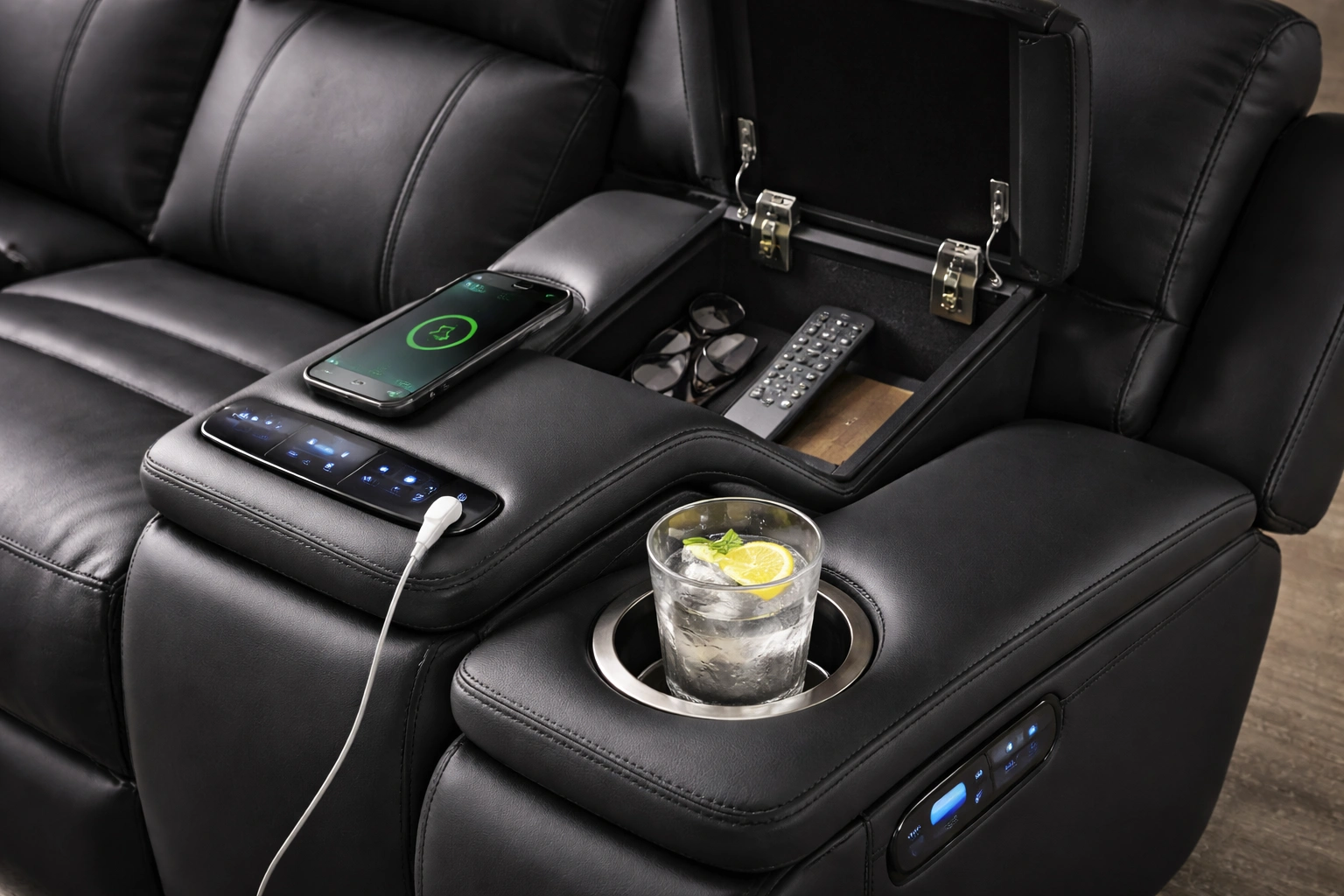
3. USB Ports & Wireless Charging: Increasingly standard on power recliners. Look for models with USB-A and USB-C ports (not just USB-A, as many newer devices use USB-C). Sofas with USB ports eliminate the need for extension cords running across your living room. Wireless charging pads built into the armrest are a premium touch.
4. Cup Holders & Storage Compartments: Built-in cup holders and storage compartments (usually in the armrest or between seats) are practical for home theater setups and family rooms. Center consoles between reclining seats may include hidden storage, cup holders, and even mini-table surfaces.
5. Zero Gravity Position: Premium recliners offer a zero-gravity recline angle that elevates your legs above heart level, distributing weight evenly and reducing spinal compression. Originally developed by NASA, this position is considered the most biomechanically neutral and is particularly beneficial for circulation and joint pressure relief.
6. Battery Backup (Power Recliners): Some power recliners include a battery backup system that allows 2–3 recline cycles even during a power outage. This is critical for lift recliners where the user may need to stand up regardless of power availability. Without battery backup, a power outage could trap a mobility-impaired user in a reclined position.
7. Cushion Quality: High-density foam (2.0 lb/ft³ or higher) wrapped in a soft fiber layer provides the best balance of support and softness for recliners. Avoid low-density foam that will flatten within months under the additional stress of reclining positions. Memory foam toppers add contouring comfort but shouldn't be the sole cushion material — they lack the resilience needed for frequent position changes.
Recliner Sofa vs. Other Sofa Types
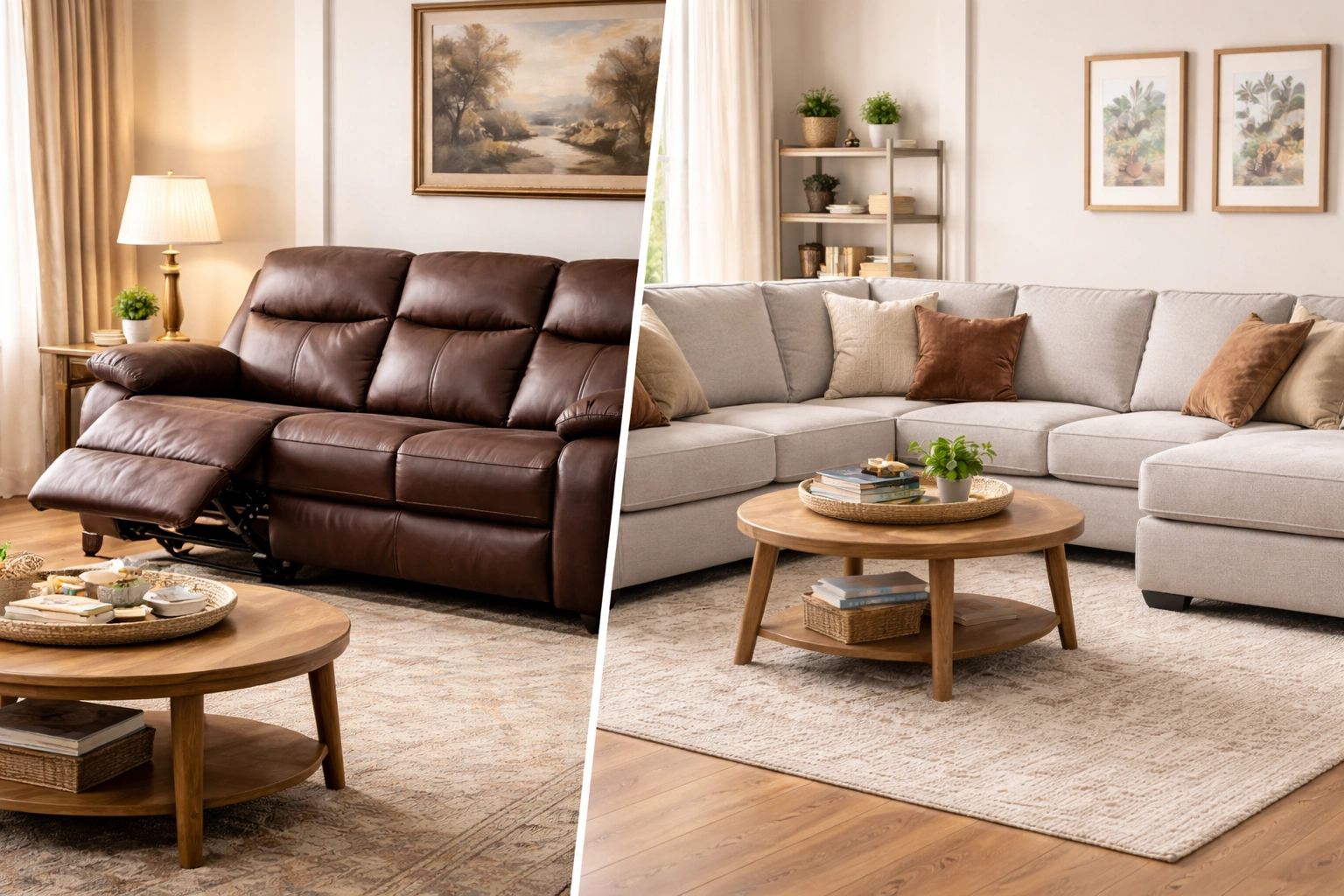
If you're torn between a recliner and another sofa style, this comparison will help clarify which option best matches your lifestyle. Each type has legitimate strengths — the key is matching those strengths to your specific needs.
| Feature | Recliner Sofa | Sectional Sofa | Sleeper Sofa | Chesterfield |
|---|---|---|---|---|
| Adjustability | Excellent — multiple positions | None — static seating | Limited — fold-down only | None — static seating |
| Sleeping Capability | Moderate — reclined position only | Poor — no bed option | Excellent — full bed | Poor — no bed option |
| Seating Capacity | 2–5 (depending on config) | 5–8+ (largest capacity) | 2–3 | 3–4 |
| Space Efficiency | Low — needs clearance | Moderate — corner placement | High — dual function | High — compact profile |
| Back Support | Excellent — adjustable | Moderate — fixed angle | Moderate — thin mattress | Moderate — tufted firmness |
| Maintenance Complexity | High — moving parts | Low — no mechanisms | Moderate — fold mechanism | Low — no mechanisms |
| Price Range | $500–$5,000+ | $800–$4,000+ | $400–$2,500 | $1,000–$5,000+ |
The recliner sofa excels in adjustability and personalized comfort but sacrifices some space efficiency and has higher maintenance needs due to its mechanical components. If your priority is maximum seating capacity, a sectional sofa wins. If you frequently host overnight guests, a sleeper sofa is more practical. But if daily comfort, back support, and relaxation are your top concerns, the recliner sofa is unmatched. For a deeper analysis of trade-offs, read our guide on comfort vs. durability.
Best Use Cases by Room
A recliner sofa isn't a one-size-fits-all solution. Where you place it dramatically affects which type, size, and features you should prioritize. Here are the most effective placements:
Primary Living Room
A 3-seater power recliner with independent headrests and premium upholstery. This is your showpiece — choose leather or high-end performance fabric. Prioritize aesthetics alongside comfort, and match the recliner's style to your room's decor.
Home Theater
Reclining sectional with cup holders, USB ports, and ideally massage/heating. Row seating works well for dedicated theater rooms. Choose dark-colored fabric to minimize light reflection from the screen.
Family Room
Durable performance fabric recliner with stain resistance. Consider a reclining sectional for maximum seating. Avoid light colors and delicate leather if you have young kids. Look for removable cushion covers for easy cleaning.
Basement / Rec Room
Value-oriented manual recliners work well here. Basements often have more flexible space, so wall clearance is less of an issue. Choose moisture-resistant materials if your basement has humidity concerns.
Office / Waiting Room
Wall-hugger 2-seater recliner in professional tones (black, brown, grey). Leather or faux leather for easy wipe-down. Avoid overly plush models — maintain a professional appearance while offering visitor comfort.
Small Apartment
Wall-hugger recliner is non-negotiable here. A 2-seater wall-hugger in a compact footprint (under 70 inches wide) maximizes comfort in minimal space. Consider a modern design with slim arms to save additional inches.
For dedicated movie watchers, our sofas for movie marathons guide pairs perfectly with recliner recommendations. And if napping is a priority, many recliners with deep seat configurations and zero-gravity positions offer better nap support than a standard bed for quick daytime rest.
Maintenance & Care Tips
Recliner sofas require more maintenance than standard sofas due to their mechanical components. Proper care not only extends the lifespan significantly but also ensures smooth, safe operation. Here's a comprehensive maintenance routine:
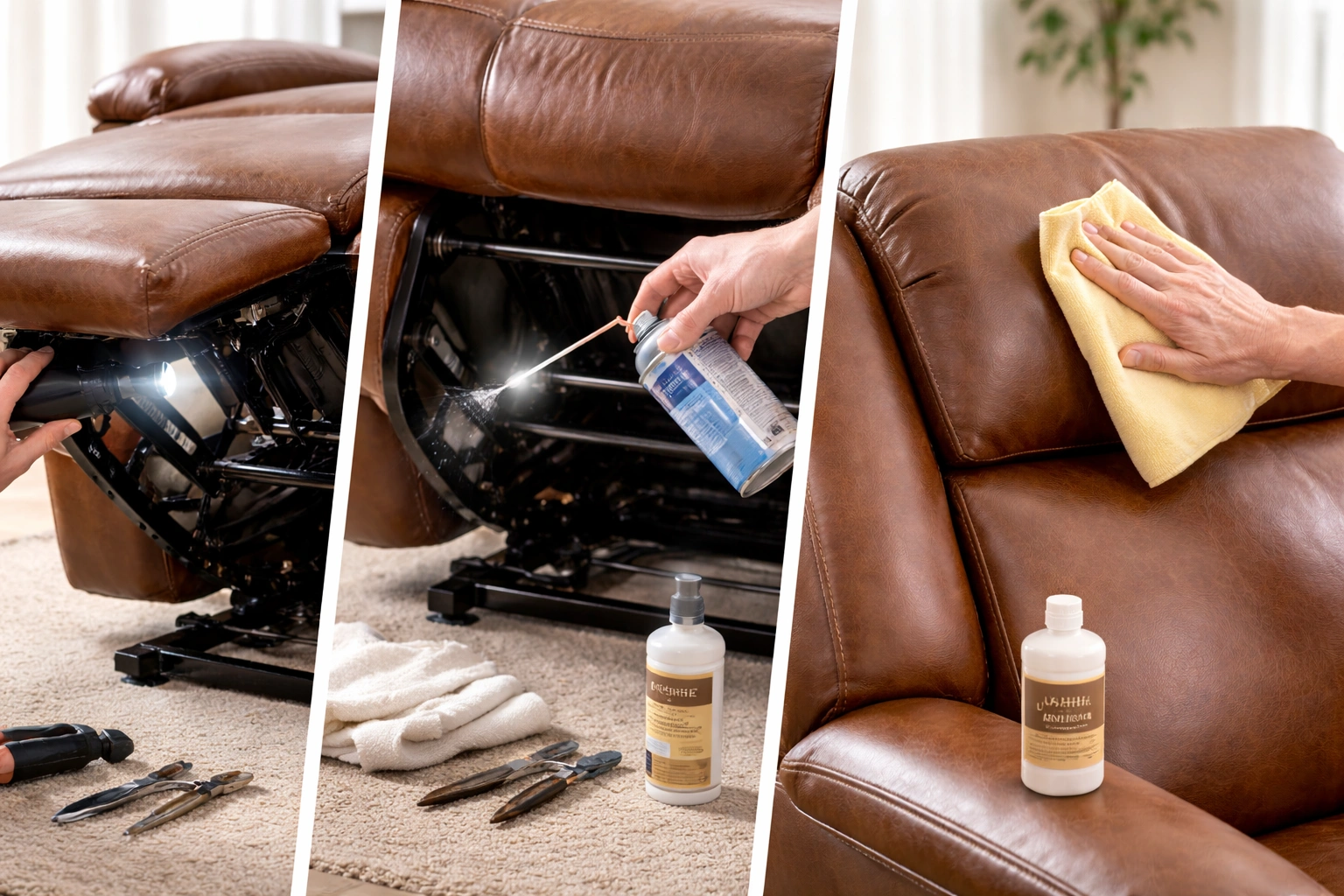
Mechanism Care (Monthly):
- Lubricate all moving joints, pivots, and springs with a silicone-based spray (avoid WD-40, which attracts dust). Apply sparingly — excess lubricant attracts dirt buildup
- Check for loose screws, bolts, and brackets. Tighten any that have worked loose from repeated reclining motion
- Inspect cables for fraying, kinks, or slack. Replace cables at the first sign of wear — a snapped cable during recline can cause sudden movement
- Test the footrest extension and retraction for smooth, even motion on both sides. Uneven movement indicates a mechanism imbalance that needs adjustment
- For power recliners, check the power cord and connections for damage. Ensure the cord isn't pinched under the base
Upholstery Care:
Leather recliners need conditioning every 3–6 months to prevent cracking at the high-stress flex points (where the backrest pivots and the footrest hinges). Use a pH-balanced leather conditioner — see our leather conditioning guide for product recommendations. For fabric recliners, regular vacuuming prevents debris from working into the reclining mechanism joints. Apply a fabric protection treatment after purchase and reapply annually. For detailed cleaning procedures for specific materials, visit our guides on cleaning leather sofas and cleaning fabric sofas.
Frame & Leg Maintenance:
Periodically inspect the frame joints and check for loose legs. The constant leverage force of reclining can gradually loosen frame connections. If you notice any wobbling or creaking that persists after lubrication, it may indicate a frame joint failing — address this promptly before it worsens. For comprehensive maintenance, our complete sofa cleaning guide covers all material types.
Common Problems & Fixes
Even quality recliners can develop issues over time. Knowing what typically goes wrong — and what you can fix yourself versus what requires professional help — saves both money and frustration. Here are the most common recliner sofa problems:
1. Recliner Won't Open or Close
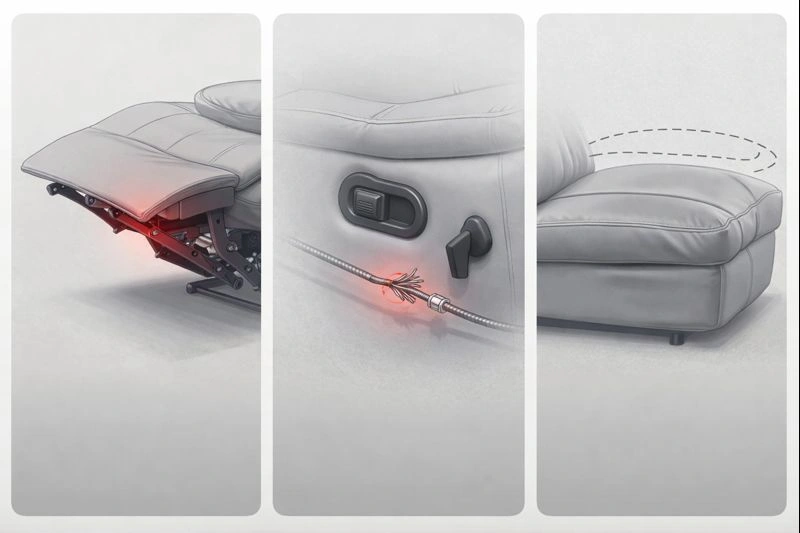
This is the most frequently reported issue. For manual recliners, the cause is usually a stretched or broken cable (90% of cases) or a jammed release latch. Cable replacement is a straightforward DIY fix — replacement cables cost $15–$30 and require only basic tools. For power recliners that won't move, first check the power source (tripped breaker, unplugged cord, blown fuse in the transformer). If power is confirmed, the motor or control switch may have failed and typically requires professional replacement.
2. Squeaking or Grinding Noises
Noises during reclining almost always indicate dry or dirty joints. Apply silicone lubricant to all visible pivot points and springs. If noise persists after lubrication, a spring may be distorted or a bushing worn out — inspect carefully and replace the affected component. Grinding noises in power recliners often point to a failing gear in the motor, which requires motor replacement.
Recliner cushions sag faster than standard sofa cushions because the reclined position concentrates body weight in smaller areas. If the cushion foam has degraded, you can add a high-density foam insert (available at fabric stores) beneath the existing cushion to restore firmness. For complete cushion replacement, check our guide on replacement cushions for a couch.
4. Footrest Won't Stay Up
The footrest is held in position by tension springs. If the footrest droops or falls, the springs have lost tension. Replacement tension springs cost $10–$25 and are easy to install. In some cases, the spring mounting bracket has bent — straighten or replace it. If the footrest closes abruptly (drops instead of easing down), the dampener cylinder needs replacement.
5. Uneven Reclining (One Side Higher Than the Other)
This indicates an imbalance in the mechanism — one side's cable is stretched more than the other, or one spring has lost more tension. Compare both sides visually and adjust or replace the uneven component. Continuing to use an imbalanced recliner accelerates wear on the mechanism and can damage the frame.
For problems not specific to recliners — like fabric pilling, odors, or wobbling — our common sofa problems & fixes guide provides additional troubleshooting steps.