
The Hidden Costs of Buying a Sofa No One Tells You About
That price tag you see online is rarely the final amount you will pay. Discover the 9 surprise fees that can add hundreds of dollars to your sofa purchase
SEE THE FULL BREAKDOWNThe reality check: Studies show that the average sofa buyer spends 15-30% more than the advertised price once all fees are added. On a $1,500 sofa, that means an extra $225 to $450 in costs that most people never anticipate until checkout — or worse, after delivery. This guide reveals every hidden fee so you can budget accurately and avoid unpleasant surprises.
Why Do Sofas Have So Many Hidden Costs?
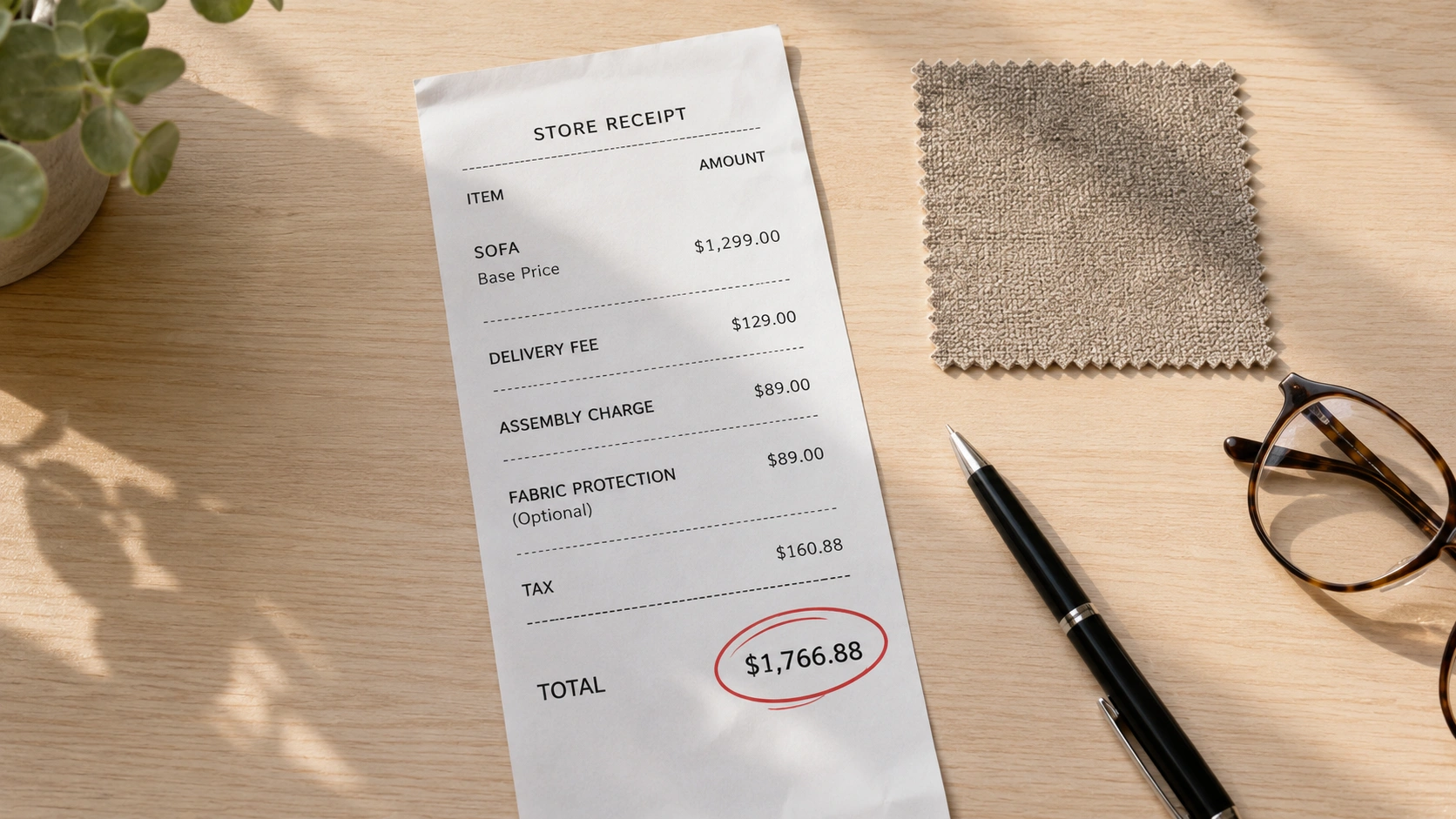
The furniture industry has developed a pricing model designed to display the lowest possible number upfront. This strategy — known as "partitioned pricing" — makes a product appear more affordable by separating mandatory or semi-mandatory costs from the base price. When you see a sofa listed at $1,299, that number typically covers only the frame, cushions, and upholstery in the most basic configuration. Everything else — getting it to your door, setting it up, protecting it, and insuring it against defects — comes as add-ons.
This practice is especially common with online retailers, where the distance between you and the product makes it easy to underestimate logistics. But even brick-and-mortar showrooms are guilty — many stores advertise "starting at" prices that apply only to the smallest size with the cheapest fabric, then add costs for upgrades, delivery, and protection during the sales process. Understanding how sofa pricing works is the first step to seeing through these tactics.
The problem is compounded by the fact that sofa shoppers typically compare prices across multiple retailers. If Store A lists a sofa at $1,200 and Store B lists a similar-looking one at $1,400, Store A appears to be the better deal — unless Store A charges $300 in delivery and setup fees while Store B includes those services. This is why understanding price versus quality relationships requires looking beyond the headline number.
The 9 Hidden Costs That Inflate Your Sofa Bill
Below is a detailed breakdown of every additional cost you are likely to encounter when buying a sofa. Each one includes typical price ranges, what the fee actually covers, and practical strategies to minimize or avoid it entirely.
Delivery & Shipping Fees
The most common hidden cost. Standard curbside delivery typically costs $50-$150, while white-glove delivery (inside placement, unpacking, and debris removal) ranges from $150-$400 or more. Large or heavy sofas like a sectional sofa usually incur higher fees due to their weight and multiple pieces.
$50 – $400+Threshold & Stair Surcharge
Many delivery companies charge extra for carrying a sofa beyond the ground-floor entrance. Threshold delivery (leaving it inside the front door) adds $25-$75. Carrying it upstairs, especially to a second or third floor, can add $50-$150 per floor. Elevator buildings may also incur a long-carry fee if the elevator is far from the entrance.
$25 – $300+Assembly Charges
Many modern sofas arrive in multiple boxes and require assembly. A modular sofa may have 6-10 separate pieces that need to be connected. Retailers often charge $50-$150 for assembly, even when the "assembly required" notice is buried in the product description. Some sleeper sofas also require mechanism installation.
$50 – $150Fabric Protection Treatment
Salespeople aggressively push fabric protection sprays at checkout, typically costing $100-$300 depending on sofa size. These treatments claim to repel stains and spills, but the markup is enormous — the actual product cost to the retailer is often under $20. Independent fabric protection products you apply yourself typically cost $30-$60 and perform just as well.
$100 – $300Extended Warranty
Most sofas come with a standard manufacturer warranty (1-5 years on frame, 1-2 years on fabric). Extended warranties add $100-$400 for 3-5 additional years of coverage. The catch: these warranties often have extensive exclusions for normal wear, fading, and fabric pilling — precisely the issues most likely to occur. Check whether your frame material already has a strong warranty before paying for extra coverage.
$100 – $400Return Shipping & Restocking Fees
If you need to return a sofa, the costs can be devastating. Return shipping for a full-size sofa typically costs $150-$400 because it requires freight shipping. Many retailers also charge a 15-25% restocking fee on top of that. On a $1,500 return, you could lose $375-$750 in fees alone. Always review the return policy carefully before purchasing — some retailers do not accept returns on sofas at all.
$150 – $750+Sales Tax Variations
Online sofa retailers often display prices without sales tax, which only gets added at checkout based on your shipping address. Depending on your state, this can add 0-10% to your total. Some states have no sales tax, while others like California charge over 9%. Cross-border purchases may also trigger additional duties or import fees that are not shown in the initial price.
0% – 10%+ of totalFinancing Interest Charges
"0% interest for 12 months" sounds appealing, but these offers often have a catch: if you fail to pay the full balance before the promotional period ends, interest is retroactively charged from the purchase date at rates of 20-30% APR. On a $2,000 sofa financed over 12 months with missed deadline, that could mean an extra $400-$600 in interest. Budget planning helps avoid this trap entirely.
$0 – $600+Ongoing Maintenance Supplies
After purchase, you will need specific cleaning and maintenance products depending on your sofa material. Leather conditioners cost $15-$30 every 3-6 months. Fabric cleaners, upholstery shampoos, and lint rollers add $20-$50 per year. If you have pets, pet-proof sofa covers add $30-$80 upfront. These recurring costs are rarely mentioned during the sales process but add up over the sofa's lifespan.
$30 – $150/year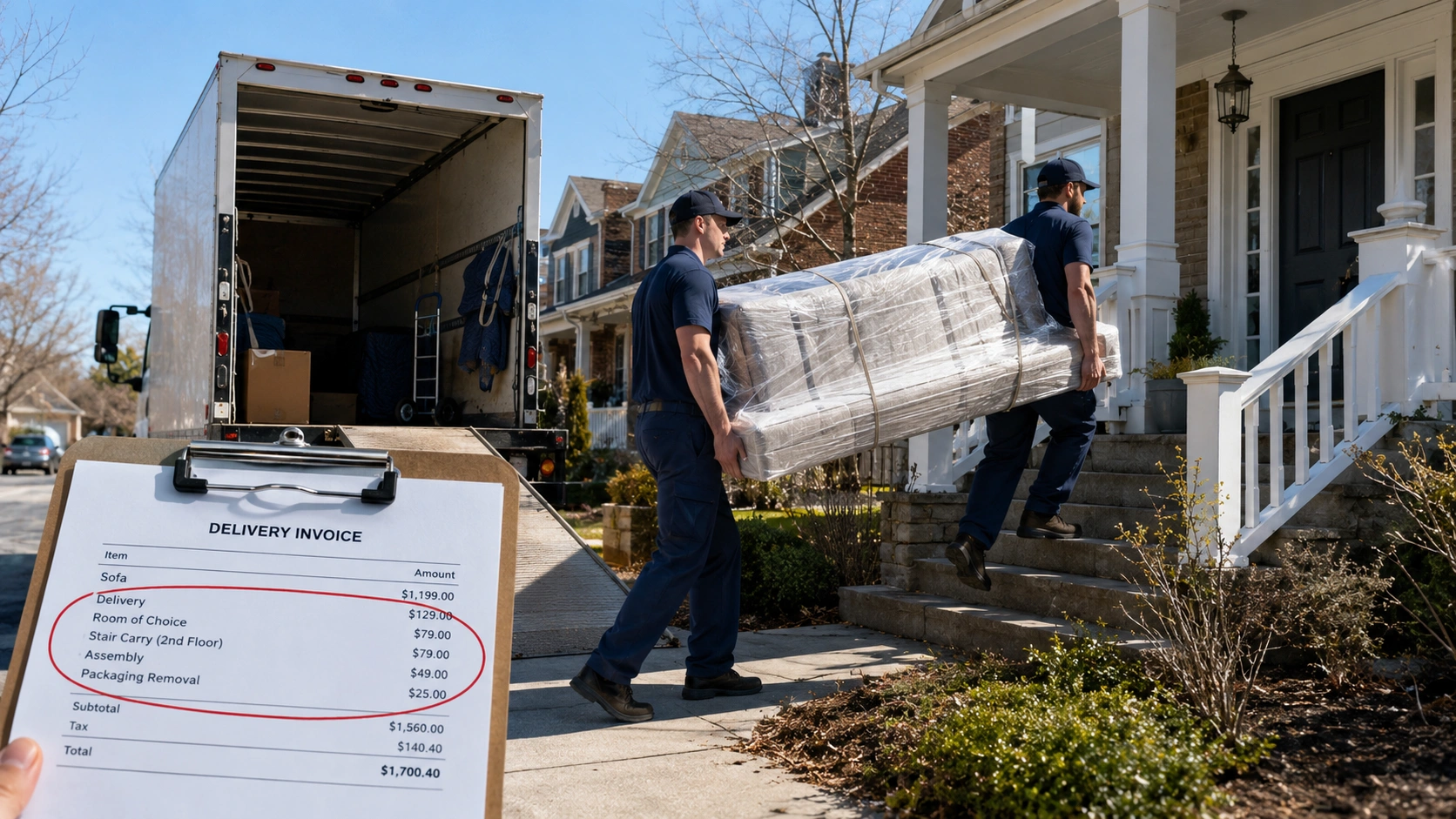
Realistic Total Cost Example
$1,690 – $2,190 For a sofa advertised at $1,500 (after all hidden fees are included)Hidden Costs by Sofa Type
Not all sofas carry the same hidden cost burden. Certain types are significantly more expensive to deliver, assemble, and maintain than others.
| Sofa Type | Typical Hidden Costs | Why Higher? |
|---|---|---|
| Sectional Sofa | $300 – $600 | Multiple boxes, heavy pieces, complex assembly, higher return shipping |
| Modular Sofa | $250 – $500 | 6-10 individual modules requiring connection hardware |
| Sleeper Sofa | $200 – $450 | Mechanism installation, extra weight, specialized delivery handling |
| Recliner Sofa | $200 – $400 | Motor wiring assembly, electronic component warranty add-ons |
| Standard 3-Seater | $150 – $350 | Lower weight, single box, minimal assembly required |
| Loveseat | $100 – $250 | Smallest footprint, lightest weight, lowest shipping class |
How to Avoid or Minimize Each Hidden Cost
Being aware of hidden costs is only half the battle. The real value is knowing exactly how to reduce or eliminate each one. Here are proven strategies for every cost category.
Delivery & Shipping
- Shop during major sale events (Memorial Day, Labor Day, Black Friday) when retailers often waive delivery fees as promotions
- Look for retailers that offer free delivery on orders above a threshold — sometimes adding a small accessory like a sofa table pushes you over the free delivery minimum
- Choose in-store pickup if you have access to a suitable vehicle — this eliminates delivery fees entirely but requires a truck, trailer, or large SUV and at least one helper
- Compare the total delivered price across retailers, not just the sofa price, before making a decision on where to buy
Fabric Protection
- Decline retailer-applied protection and purchase a highly-rated third-party spray like Scotchgard or FabricShield for $20-$40
- Consider washable sofas that allow you to remove and machine-wash covers, eliminating the need for stain protection treatments entirely
- Invest in a quality slipcovered sofa or aftermarket slipcover ($50-$150) instead of chemical treatments
Extended Warranty
- Read the manufacturer's standard warranty thoroughly — many premium sofas already include 5-10 year frame warranties at no extra cost
- Pay with a credit card that offers extended warranty protection as a cardholder benefit (many Visa Signature and Amex cards double manufacturer warranties up to 1 extra year)
- Only buy extended warranties for recliner sofas or motorized models where mechanical failure is a genuine risk — skip them for standard fixed-frame sofas
Return Costs
- Test the sofa in person before buying whenever possible — use our 7-point comfort test to evaluate thoroughly in the showroom
- Verify the retailer's return window and restocking fee policy before completing the purchase — some allow 30 days with no restocking fee, others charge 25% and only give 14 days
- Measure your space carefully using our sofa measurement guide to prevent size-related returns, which are the most common and most expensive
- Order fabric swatches first ($2-$5 each) to verify color and texture before committing to the full sofa
Red Flags That Signal Hidden Costs Are Coming
Certain pricing patterns and sales tactics are reliable indicators that a retailer is about to hit you with surprise fees. Learning to recognize these warning signs can save you hundreds of dollars and considerable frustration.
- "Starting at" pricing — The advertised price applies only to the smallest size with the cheapest fabric option. Upgrading to a normal size or decent fabric can add $300-$800 to the base price before any fees are applied
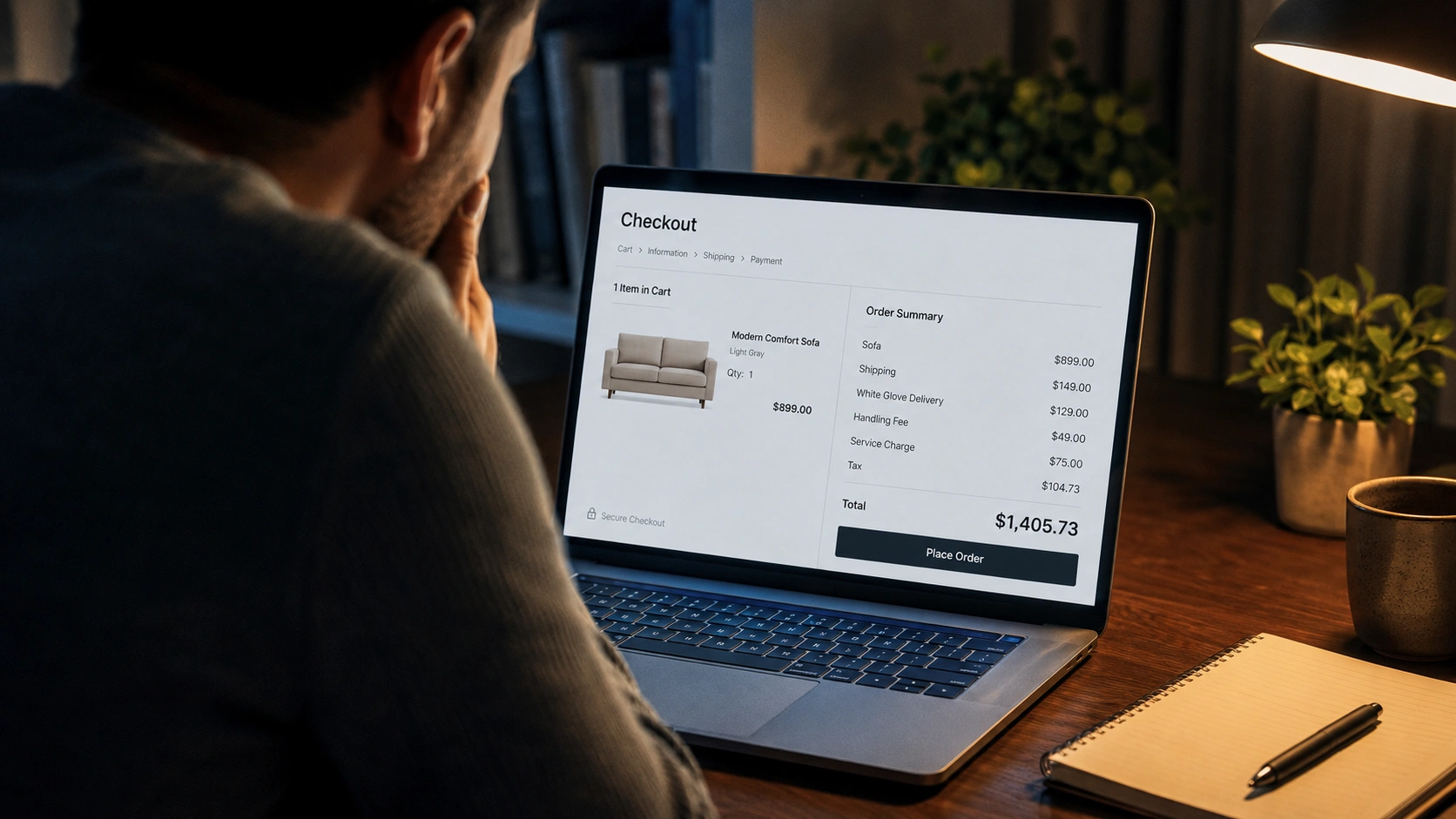
- No delivery cost visible until checkout — Retailers that hide shipping fees until the final payment step are counting on you being too committed to back out
- Aggressive fabric protection pitch — If a salesperson spends significant time pushing protection treatments, the profit margin on those products is likely very high, meaning you are overpaying
- Vague warranty terms — If the warranty description uses phrases like "select components" or "under normal use conditions" without specifics, the coverage is likely narrow and full of exclusions
- Return policy requires "original packaging" — This is especially problematic for sofas shipped in multiple boxes, since re-packing a large sofa in its original cartons is practically impossible for most consumers
- "Final sale" or "no returns" notation in fine print — Some online sofa retailers classify their products as custom orders (even for stock items) to avoid accepting returns
Smart Budgeting Framework for Sofa Purchases
Instead of treating hidden costs as surprises, build them into your budget from the start. Our recommended approach uses a simple three-tier budget that accounts for the full cost of ownership.
Tier 1 — Sofa Base Price (70% of total budget): This is the amount you allocate for the sofa itself. If your total budget is $2,000, plan to spend no more than $1,400 on the base price to leave room for everything else. This naturally guides you toward appropriately priced options and prevents you from maxing out your budget on the sticker price alone.
Tier 2 — Mandatory Add-Ons (20% of total budget): Delivery, sales tax, and any required assembly fall here. For a $2,000 total budget, this reserves $400 — enough to cover standard delivery ($100-$200), sales tax (varies), and potential stair or threshold surcharges.
Tier 3 — Optional & Ongoing Costs (10% of total budget): This covers fabric protection, extended warranty, and your first year of maintenance supplies. At $200, you can afford a quality third-party fabric protector ($30), cleaning supplies ($40), and still have $130 left as a buffer for unexpected charges.
This framework also helps when evaluating whether a custom sofa is worth the investment. Custom orders typically have higher base prices, longer lead times, and stricter return policies (often no returns at all), which means the hidden cost risk is substantially greater than with ready-made options.
Frequently Asked Questions
Continue Your Research
These related guides complement this article and help you make a fully informed purchase decision.


