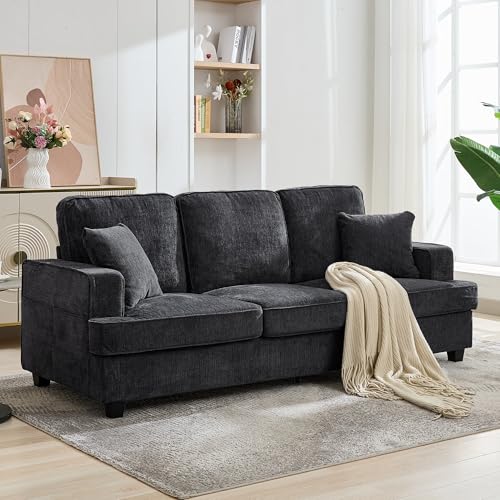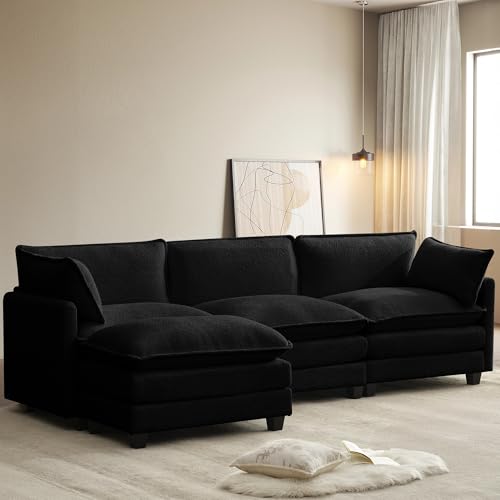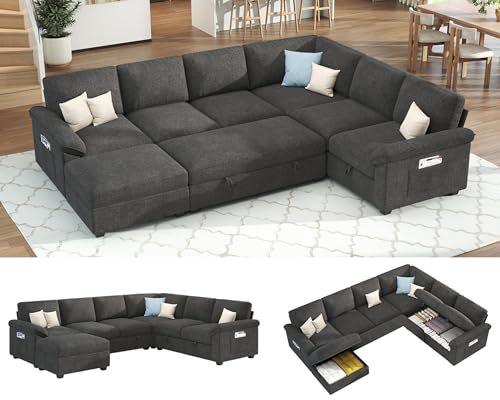
Best Sofas for Large Rooms
A complete guide to choosing, sizing, and arranging sofas that fill spacious living areas with comfort and style
EXPLORE SOFA TYPES
A well-proportioned sectional anchors this spacious living room without overwhelming the layout
Why Large Rooms Demand a Different Approach
Furnishing a large living room presents a unique set of challenges that go far beyond simply buying a bigger sofa. While small spaces demand clever space-saving solutions, spacious rooms require careful attention to scale, proportion, and visual balance. A standard three-seater in a 400-square-foot living room looks lost, disconnected, and can make the entire space feel cold and uninviting rather than luxurious.
The goal is not to fill every square foot, but to create a cohesive seating area that feels intentional and grounded. This means selecting sofas with enough visual weight to hold their own, arranging complementary pieces at the right scale, and using layout strategies that define intimate zones within an open floor plan.
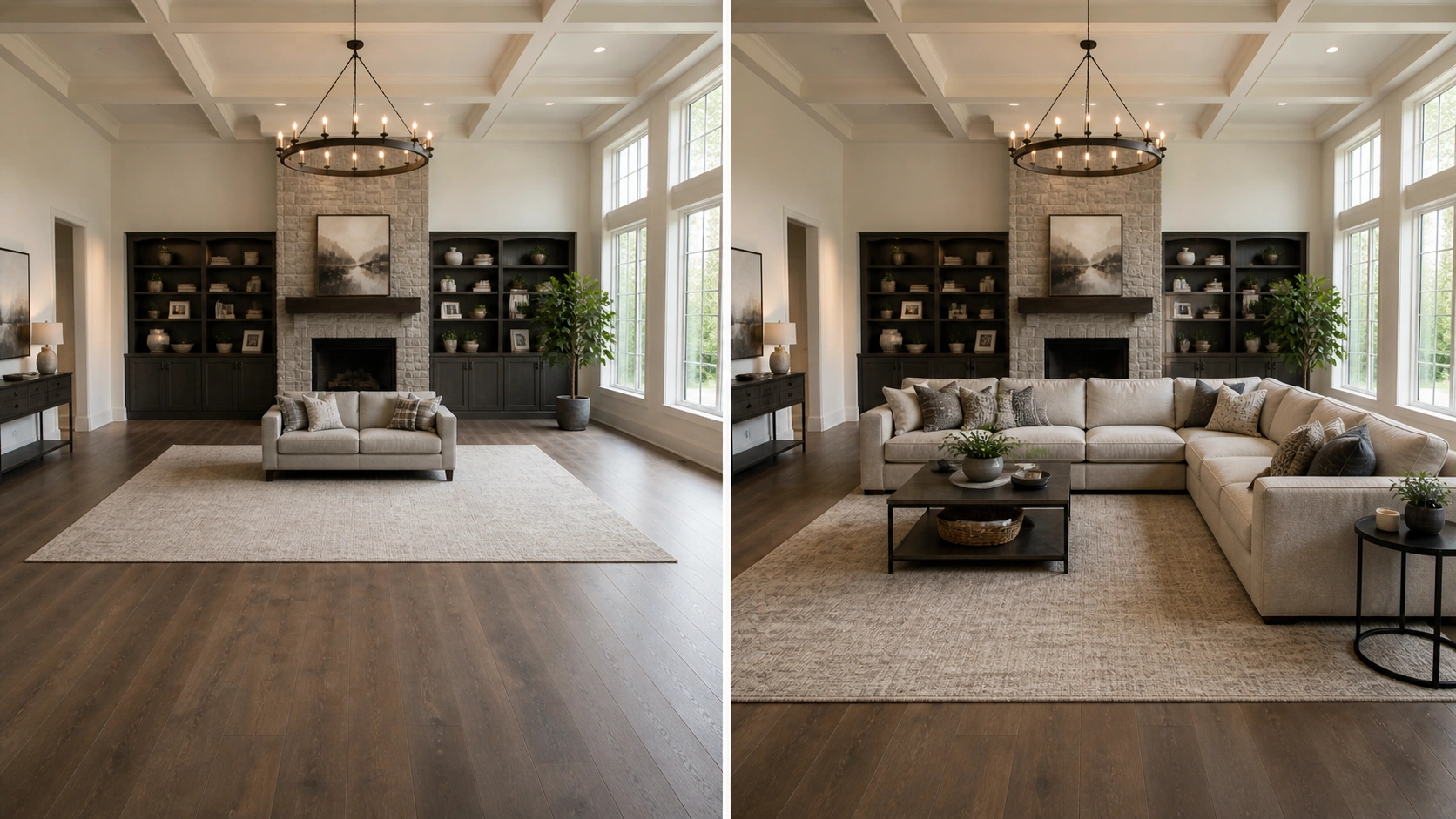
An undersized sofa (left) appears lost in a spacious room, while a properly scaled sectional (right) creates a balanced, inviting arrangement
In this guide, we break down everything you need to know about choosing the right sofa for a large room — from understanding correct proportions and selecting the best sofa types, to proven layout techniques that transform an empty expanse into a warm, functional gathering space.
Understanding Proportions: Scaling Sofa to Room
The single most common mistake when furnishing a large room is choosing a sofa that is too small. To avoid this, you need to understand the relationship between room dimensions, sofa dimensions, and the negative space (walkways and breathing room) around the furniture.
The Two-Thirds Rule
A widely accepted principle in interior design states that your sofa should span roughly two-thirds of the wall it sits against. In a large room with a 180-inch primary wall, this means your sofa should measure approximately 110 to 120 inches wide. This creates visual balance without crowding the space.
Pro Tip: If your sofa does not sit against a wall — for instance, in an open-concept layout where it floats in the middle of the room — apply the two-thirds rule to the seating area itself rather than a wall. Define your intended seating zone first, then scale the sofa to fit that zone.
Room Size to Sofa Size Reference
| Room Size | Sofa Width Range | Recommended Type |
|---|---|---|
| 200 – 300 sq ft | 90 – 100 inches | Standard 3-seater or small L-sectional |
| 300 – 400 sq ft | 100 – 115 inches | Large L-sectional or 4-seater |
| 400 – 500 sq ft | 115 – 130 inches | U-shaped sectional or modular system |
| 500+ sq ft | 130+ inches | Large modular configuration or multi-piece arrangement |
Accounting for Pathways
While a large sofa is essential, you must maintain adequate walkways. Leave at least 36 inches for main traffic paths and 18 to 24 inches between the coffee table and the sofa edge. In large rooms, you have the luxury to space things out comfortably, so resist the temptation to push everything together or spread it too far apart. For a detailed breakdown of measuring techniques, our sofa measurement guide covers the process step by step.
Common Pitfall: Measuring only wall length and ignoring door openings, window placements, and traffic flow patterns. Always map your room on paper before shopping, noting every fixed element that could limit your sofa placement.
Best Sofa Types for Large Living Rooms
Not every sofa style translates well to a spacious environment. The following types are particularly effective at filling large rooms with presence and purpose.

L-Shaped Sectional
The most popular choice for large rooms. The perpendicular extension fills corner space that would otherwise feel empty and creates a natural boundary for the seating area.

U-Shaped Sectional
Ideal for rooms over 400 sq ft. Wraps around three sides to create an immersive, conversational zone perfect for families and those who host frequently.
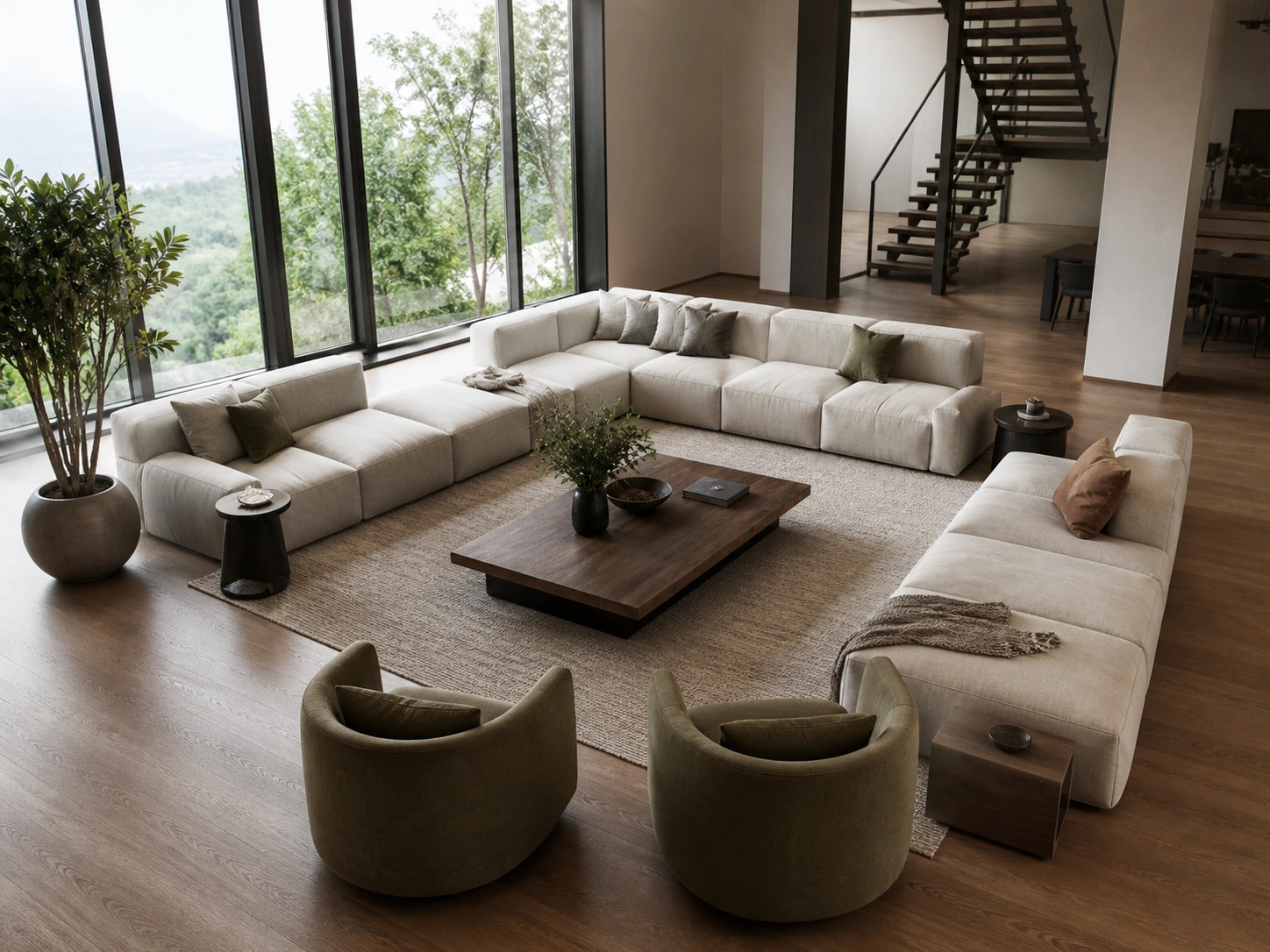
Modular Sofa
Individual pieces that you arrange to fit your exact room shape. Perfect for irregular layouts, open-concept spaces, and anyone who likes to periodically rethink their arrangement.

Curved Sofa
Makes a bold design statement while softening the angular lines of a large room. Works especially well centered in open spaces or positioned to face a focal point like a fireplace.
Deep Dive: Sectionals vs. Traditional Sofas
The debate between a sectional and a traditional sofa becomes especially relevant in large rooms. A traditional sofa, even an extra-long one, creates a linear seating arrangement that works well in formal settings or when you want to maintain clear sightlines across the room. However, it rarely fills enough volume on its own and typically requires additional accent chairs or a chaise to feel complete.
A sectional, by contrast, occupies floor area in two dimensions, making it far more efficient at defining a seating zone. For large family rooms and open-concept living areas, sectionals consistently outperform traditional sofas in both comfort and spatial efficiency. If you are deciding between the two, read our detailed comparison of sectional sofas to understand the trade-offs in depth.
When to Consider a Multi-Piece Arrangement
In some large rooms, a single sofa — even a massive sectional — may not be the best approach. A multi-piece arrangement using a sofa paired with a chaise lounge, two accent chairs, and an ottoman can create a more dynamic, layered look. This approach is ideal if your large room serves multiple functions, such as combining a conversation area with a reading nook or a game zone. The key is ensuring all pieces share a consistent scale and design language so the arrangement feels cohesive rather than random.
Sofa Configurations for Large Spaces
How you configure your sofa relative to the room architecture dramatically affects both function and aesthetics. Below are the most effective configurations for large rooms.
Floating the Sofa
Instead of pushing the sofa against a wall, float it 18 to 36 inches into the room. This technique is one of the most powerful tools for large spaces because it accomplishes three things simultaneously: it creates a more intimate seating area, opens up wall space for shelving or art, and establishes clear walkways behind the sofa. Floating works best with sectionals and modular pieces that have an attractive back finish.
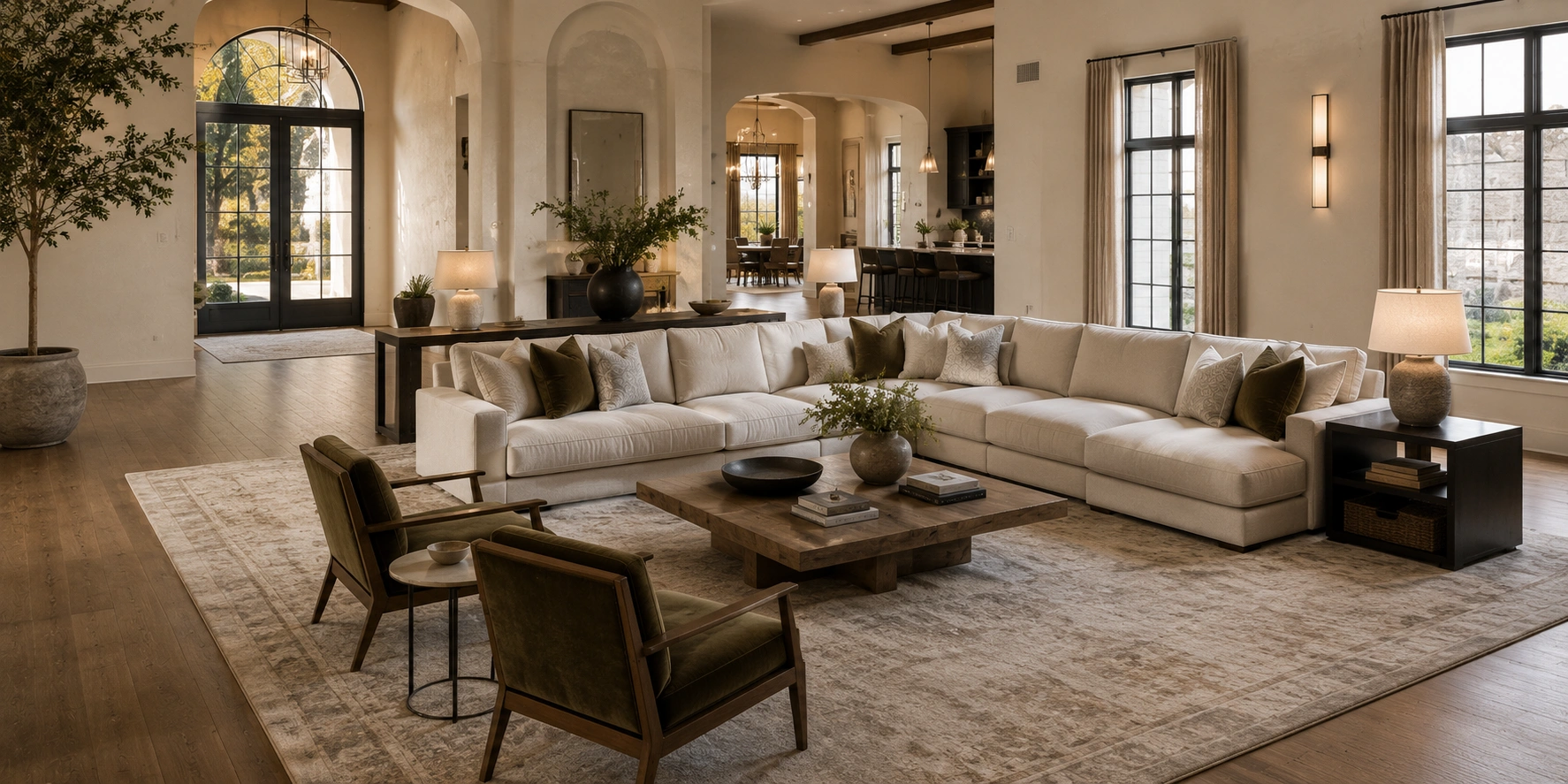
Floating a sectional away from the wall creates a defined seating island and opens the perimeter for additional furniture
Dividing Open-Concept Spaces
In homes with open-concept floor plans, a large sofa can serve as a subtle room divider. Positioning an L-shaped or U-shaped sectional with its back facing the kitchen or dining area delineates the living zone without erecting walls. A modular sofa excels in this role because you can adjust the configuration as your needs evolve.
Anchoring a Focal Point
Every well-designed large room needs a focal point — a fireplace, a large window with a view, a media wall, or a piece of statement art. Your sofa should face this focal point directly. In very large rooms, a U-shaped configuration centered on the fireplace creates a symmetrical, balanced composition that feels both grand and inviting. Pair it with a substantial coffee table and two matching accent chairs to complete the arrangement.
Creating Multiple Zones
Rooms exceeding 500 square feet often benefit from being divided into two distinct zones: a primary conversation area anchored by the main sofa, and a secondary area — perhaps a reading corner with a sofa chair or a futon sofa for occasional guests. Use area rugs, lighting, and furniture placement to visually separate these zones while maintaining a cohesive design thread through color and material choices.
Layout Tip: For more detailed strategies on arranging furniture in any room shape, our living room layout guide covers rectangular, square, narrow, and open-concept floor plans with visual diagrams.
Material Considerations for High-Traffic Large Rooms
Large living rooms tend to be high-traffic areas, especially in households with children or frequent guests. The materials you choose must balance aesthetics with long-term durability.
Performance Fabrics
Performance fabrics such as crypton, sunbrella, and microfiber are engineered to resist stains, fading, and wear. For large family rooms, these materials offer peace of mind without sacrificing comfort or style. When evaluating fabric durability, look for high scores on the Martindale abrasion test — anything above 30,000 cycles is considered suitable for heavy domestic use, and 50,000+ is ideal for large households.
Leather for a Statement Look
Leather sofas carry significant visual weight, making them naturally suited for large rooms where a lightweight fabric piece might look insubstantial. Full-grain and top-grain leather develop a beautiful patina over time and are exceptionally easy to clean. However, they require regular conditioning and are susceptible to scratching from pets. To decide whether leather is right for your household, read our comprehensive leather vs fabric comparison.
Frame Construction Matters at Scale
A large sofa places more demands on its frame than a compact one. At this size, a weak frame leads to sagging, creaking, and premature failure. Prioritize kiln-dried hardwood frames with reinforced joints — dovetail, mortise-and-tenon, or corner-blocked constructions. Our guide to sofa frame materials explains what to look for and what to avoid when evaluating build quality.
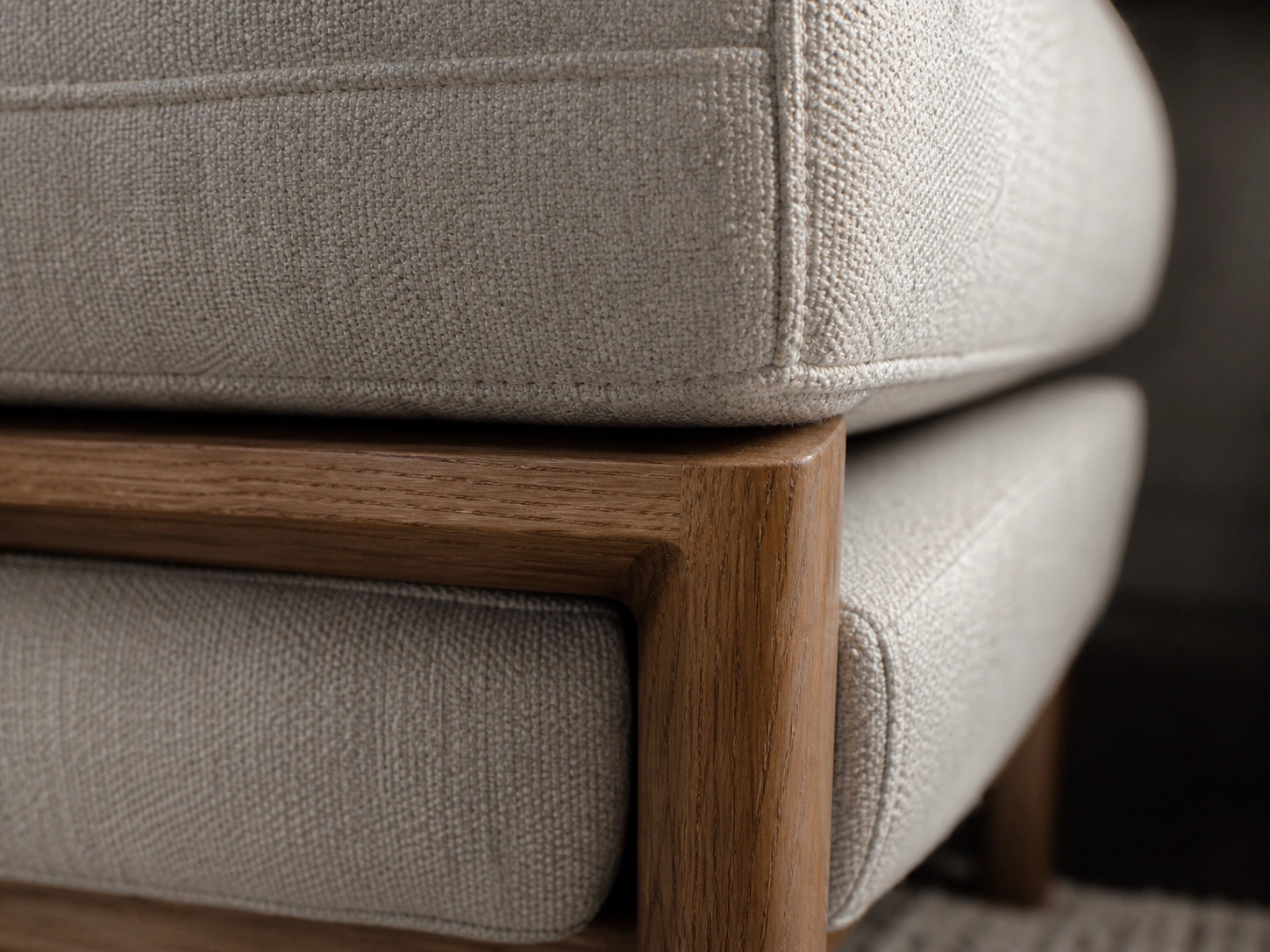
Durable performance fabric paired with a kiln-dried hardwood frame ensures a large sofa withstands years of daily use
Cushion Fill and Seat Depth
In a large room, people tend to sit back more fully, so seat depth becomes especially important. A deeper seat (22 to 24 inches) encourages lounging, while a standard depth (20 to 22 inches) supports more upright posture. For cushion fill, high-resilience foam wrapped in a down blend offers the best balance of support and plushness for large sofas. Explore the options in our cushion fill types guide to find the right feel for your household.
Layout Strategies That Transform Large Rooms
Even the perfect sofa will underperform if the surrounding layout does not support it. These proven strategies help large rooms feel polished and purposeful.
Layer with an Oversized Area Rug
An area rug should extend at least 12 to 18 inches beyond the sofa on all sides. In a large room, this often means selecting a rug that is 9x12 feet or larger. The rug anchors the seating area visually and prevents the sofa from appearing to float on an ocean of bare floor. If your room has an open-concept layout, the rug also helps define where the living area ends and the dining or kitchen area begins.
Add Weight with Complementary Furniture
A large sofa needs substantial companions. A delicate side table will look out of place next to an oversized sectional. Instead, pair your sofa with a chunky coffee table, oversized floor lamps, a tall bookcase, or a console table behind it. These elements add visual weight that balances the sofa's presence and fills vertical space.
Use Vertical Elements
Large rooms often have high ceilings that can make furniture feel dwarfed. Draw the eye upward with tall bookcases, vertical shiplap or wainscoting, large-scale artwork, or statement pendant lights. Vertical elements bridge the gap between the furniture and the ceiling, making the entire room feel proportioned and intentional.
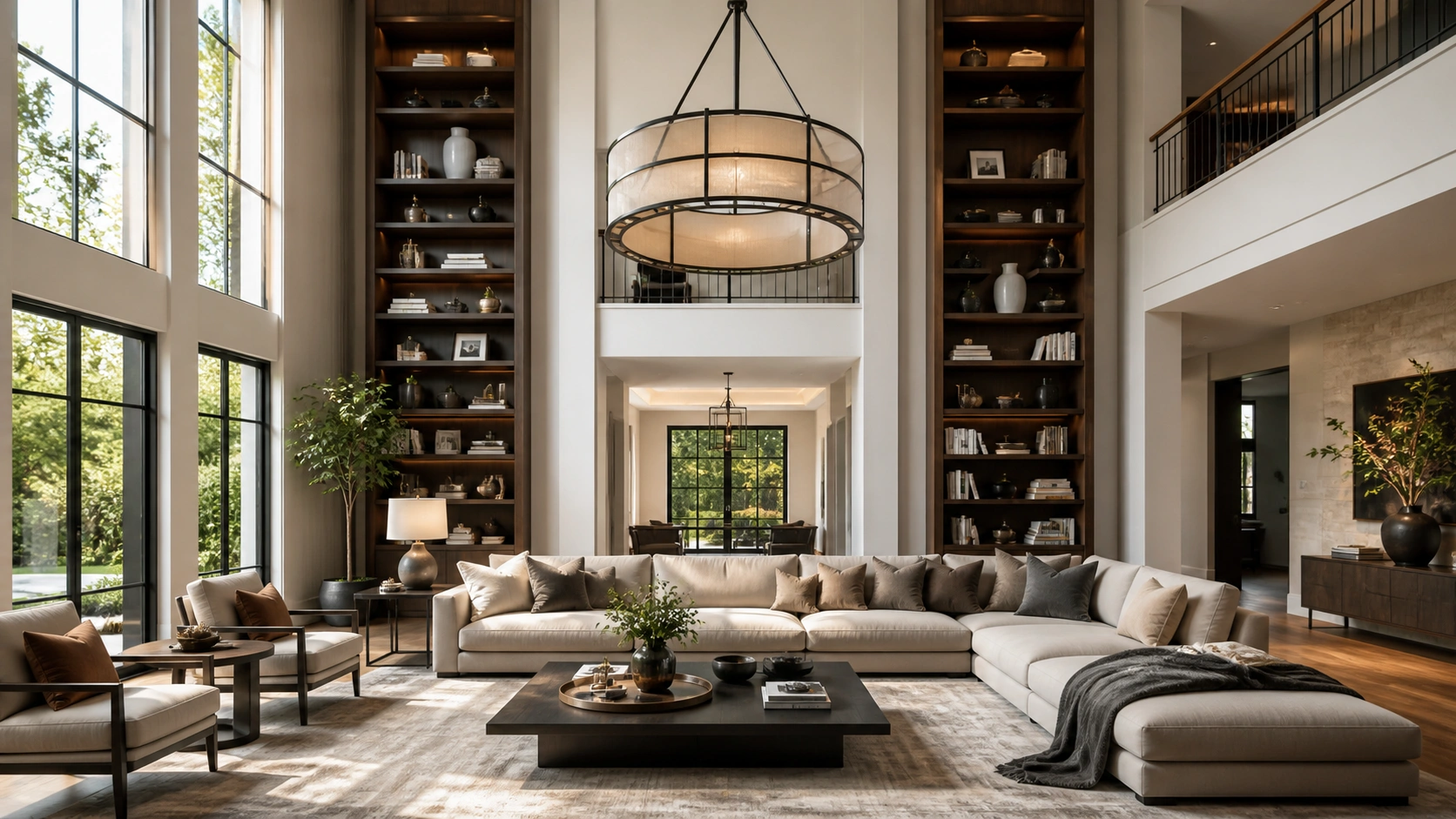
Tall bookcases and a statement pendant light add vertical weight that prevents the sectional from feeling dwarfed by high ceilings
Create Symmetry for Formal Spaces
If your large room serves as a formal living area, symmetry is your most powerful tool. Center your sofa on the primary wall or focal point, flank it with matching accent chairs, and mirror the arrangement with matching side tables and lamps. This classical approach creates a sense of order and grandeur that smaller layouts cannot achieve.
Embrace Asymmetry for Relaxed Spaces
For family rooms and casual living areas, an asymmetric arrangement feels more relaxed and approachable. Offset the sofa slightly from center, pair it with mismatched but complementary chairs, and layer different textures. This approach works particularly well in family room settings where comfort takes priority over formality.
Common Mistakes When Choosing Sofas for Large Rooms
Even experienced shoppers make errors when scaling up. Avoid these frequent missteps to ensure your investment pays off.
- Buying too small: The most prevalent error. When in doubt, go bigger. A sofa that feels slightly too large in the store will almost always look better at home than one that feels slightly too small.
- Ignores the back of the sofa: In a large room where the sofa may be floated or visible from multiple angles, a finished back is essential. An unfinished or cheap-looking back panel undermines the entire arrangement.
- Skipping the floor plan: Eyeballing dimensions instead of creating a scaled floor plan leads to surprises on delivery day. Always map the room and tape out the sofa footprint on the floor before purchasing.
- Under-scaling accessories: A tiny throw pillow, a delicate lamp, or a small rug next to a massive sectional looks jarring. Scale every accessory to match the sofa's proportions.
- Neglecting delivery logistics: Large sectionals come in multiple boxes and require significant assembly. Measure doorways, hallways, and staircases to ensure the pieces can reach your living room. If you are ordering online, check the return policy in case the fit is not what you expected.
- Sacrificing comfort for looks: A stunning sofa that feels hard or uncomfortable defeats its purpose. Always test seat depth, cushion firmness, and back support before committing. Our guide on how to test sofa comfort provides a practical checklist.
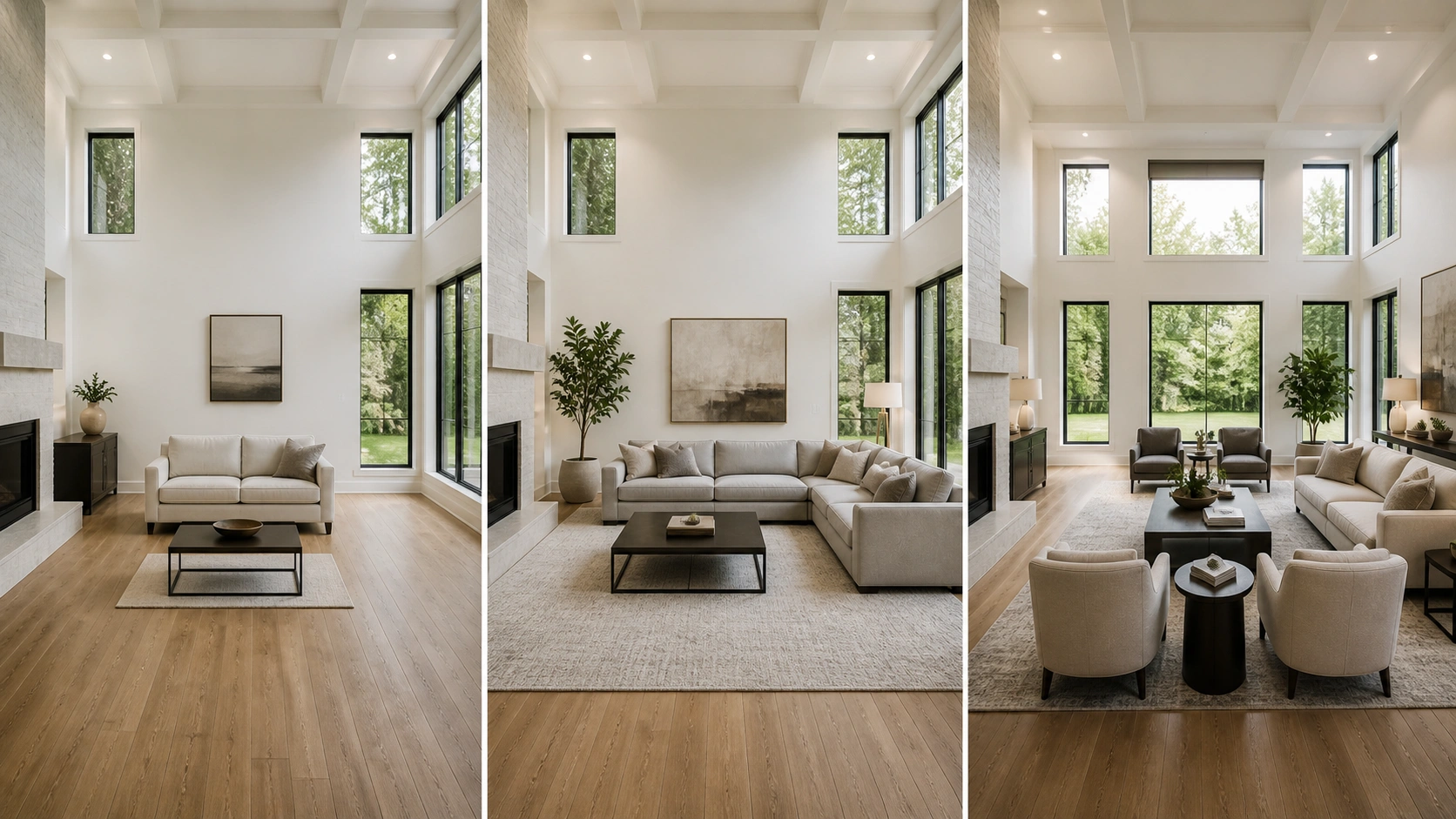
From left to right: undersized sofa with tiny rug, properly scaled sectional with oversized rug, and well-balanced multi-piece arrangement
Frequently Asked Questions
What size sofa is best for a large living room?
For a large living room (300+ sq ft), sofas between 100 and 120 inches wide work well. Sectionals can extend to 130 inches or more. The key is ensuring the sofa occupies roughly two-thirds of the primary wall without blocking pathways. For specific sizing guidance by room dimensions, see our room-to-sofa size guide.
Should I buy one large sofa or multiple smaller pieces for a big room?
It depends on your lifestyle. A single large sectional creates a unified focal point, ideal for families and movie lovers. Multiple smaller pieces offer flexibility for hosting and can define separate zones within an open-concept space. If you frequently host guests, explore our guide to sofas for frequent hosting.
How do I prevent a sofa from looking lost in a large room?
Anchor the sofa with a large area rug that extends beyond its footprint, add a substantial coffee table, flank it with oversized floor lamps or bookcases, and use an accent wall behind it. Layering textures and adding complementary furniture at the same scale also helps.
What sofa style works best in a spacious living room?
L-shaped and U-shaped sectionals are top choices because they fill space without feeling sparse. Modular sofas offer customization for odd-shaped rooms, while curved sofas add elegance and definition to open areas. Chesterfield and overstuffed designs also carry enough visual weight for large rooms.
How far should a sofa be from the wall in a large room?
In a large room, floating the sofa 12 to 36 inches from the wall creates a more intimate seating area and allows for walkways behind it. This technique also helps define zones in open-concept layouts.
Is a deep-seat sofa better for a large room?
Deep-seat sofas (22 to 24 inches) encourage lounging and are popular in large, casual family rooms. However, they may not suit shorter individuals or those who prefer upright posture. Compare the options in our standard vs deep seat guide to find the right depth for your household.
Final Thoughts
Furnishing a large living room is an opportunity, not a challenge. With the right sofa choice — one that respects the scale of the space, serves your lifestyle, and is built to last — you can transform an expansive area into a warm, inviting gathering place that your family and guests will love.
Remember the core principles: follow the two-thirds rule for wall proportion, choose sofa types with enough visual weight (sectionals, modular systems, and curved designs excel here), invest in durable materials and solid frame construction, and layer the space with appropriately scaled accessories and vertical elements.
Take the time to measure carefully, create a floor plan, and test comfort before you buy. A well-chosen sofa is the foundation of your entire living room, and in a large space, that foundation needs to be exceptionally strong. When you get it right, the result is a room that feels both grand and genuinely livable — a space that works beautifully for quiet evenings and lively gatherings alike.