Sectional Sofa: The Complete Buying Guide
L-shape, U-shape, curved, reclining — learn every configuration, size, material option, and room-planning strategy to find the perfect sectional for your space.
The sectional sofa is the most popular sofa category in North America, and for good reason: no other furniture type maximizes seating capacity while defining a room's layout as effectively. Unlike a standard sofa, a sectional wraps around corners, fills open-concept spaces with intentionality, and eliminates the need for extra armchairs. But choosing the wrong configuration, size, or material can turn what should be a room's anchor into a costly mistake. This guide covers everything you need to evaluate before purchasing — so you can buy with confidence.
Table of Contents
1. What Is a Sectional Sofa?
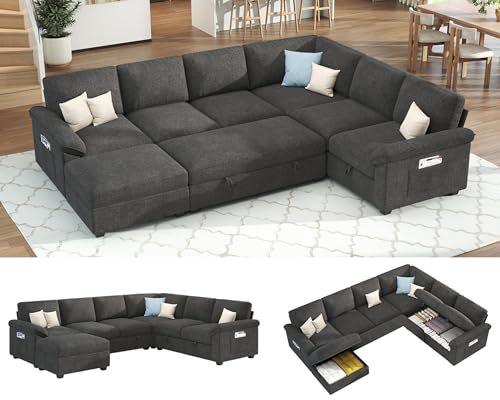
A sectional sofa is a multi-piece seating system composed of two or more connected sections that form a continuous seating arrangement. Unlike a standard 3-seater sofa with a single frame, a sectional is built from distinct modules — typically a main sofa section, a chaise or corner piece, and sometimes additional middle or end modules — that join together to create an L-shape, U-shape, or custom layout.

The key distinction between a sectional and a modular sofa lies in permanence. Sectional pieces are typically connected via clips, bolts, or brackets and designed to stay in one fixed configuration. Modular sofas, by contrast, consist of fully independent pieces that can be rearranged freely at any time. Some modern designs blur this line — see our sectional vs. traditional sofa comparison for a deeper analysis.
Sectionals have become the dominant choice for large rooms and open-concept floor plans because they solve a fundamental problem: how to provide ample seating without cluttering the room with multiple separate furniture pieces. A single well-placed sectional can seat 5–8 people while creating natural traffic flow boundaries and defining distinct zones within an open space.
2. L-Shape vs. U-Shape vs. Other Configurations
The configuration you choose determines how the sectional interacts with your room's architecture, traffic patterns, and focal points. This is the single most important decision in the buying process — more critical than material or even size.

L-Shape Sectional
The most popular configuration. Two perpendicular sections form a right angle. Ideal for anchoring a corner, defining a zone in an open plan, or floating as a room divider. The chaise extension can face left or right — this must match your room layout.

U-Shape Sectional
Three sides of seating create an enclosed, conversational arrangement. Best for large rooms (300+ sq ft) and family rooms where face-to-face interaction matters. Requires significant floor space — minimum 10×10 ft clear area recommended.

Curved Sectional
Features a gentle arc instead of sharp angles. Creates a flowing, organic feel and works beautifully in round rooms, under circular light fixtures, or as a soft boundary in open plans. Less common and typically more expensive.

Divided / Split Sectional
Two separate seating pieces that coordinate visually but sit apart with a small gap — perfect for a narrow console table or walkway between them. Combines the sectional aesthetic with the flexibility of separate pieces.
Left-Facing vs. Right-Facing: When shopping for an L-shape sectional, you will see "left-arm facing" (LAF) and "right-arm facing" (RAF) options. This refers to the side where the shorter chaise extension sits when you are facing the sofa. Stand in the room where the sofa will go, face the wall it will sit against — the side where you want the extension determines LAF or RAF. Getting this wrong is one of the most common ordering mistakes.
3. Types of Sectional Sofas
Beyond shape configuration, sectionals come in specialized functional types designed for different lifestyles and needs. Here are the most common varieties you will encounter.
Reclining Sectional
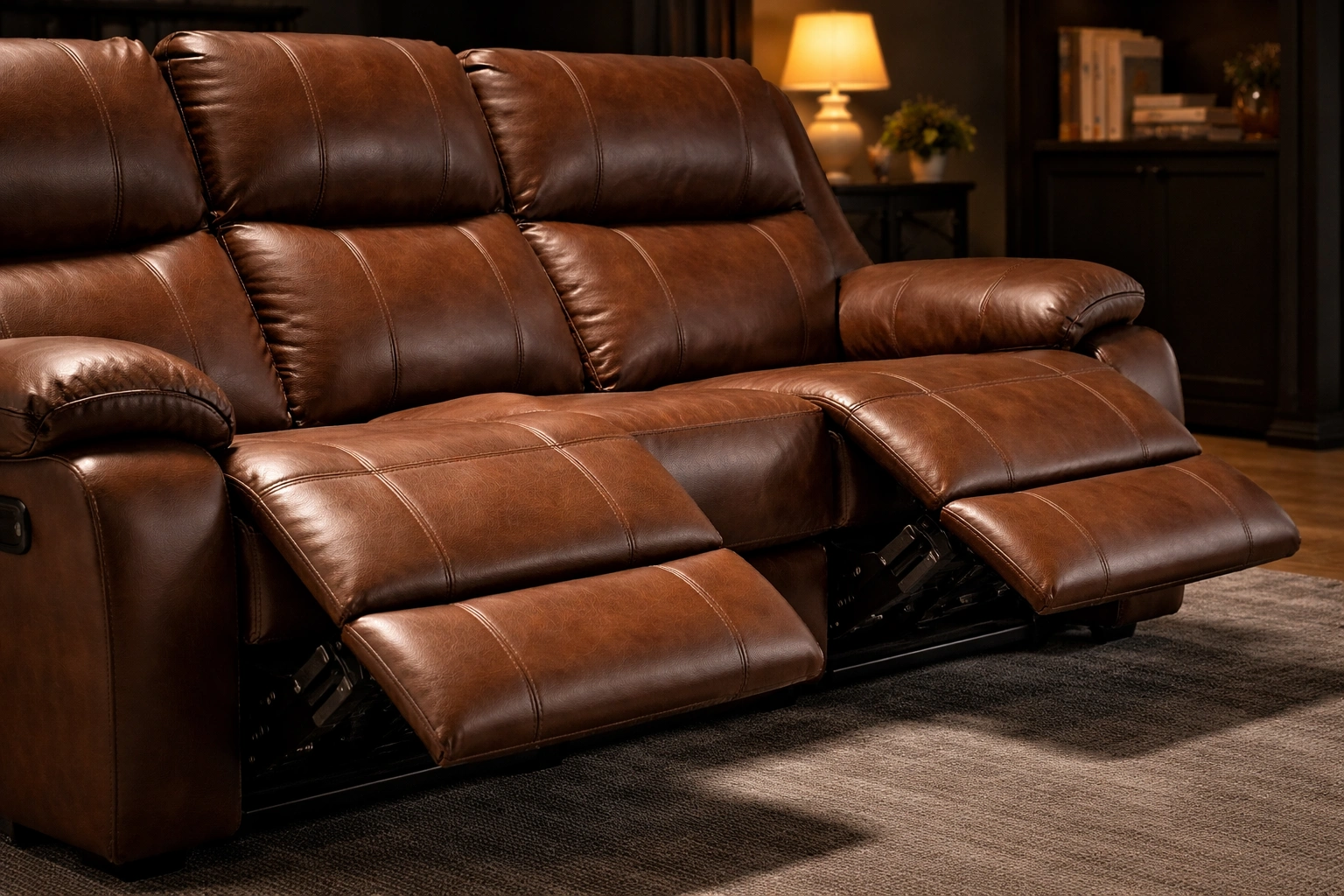
Combines the spaciousness of a sectional with built-in recliner mechanisms on some or all seats. Available as manual (lever-pull) or power (button-controlled, sometimes with USB ports). Reclining sectionals need extra clearance behind them — typically 4–6 inches from the wall for manual, 3–5 inches for wall-hugger designs. These are excellent for home theater rooms and movie marathon enthusiasts.

Sleeper Sectional
A sleeper sofa integrated into a sectional frame. The bed mechanism is typically housed in the longest section and comes in full, queen, or even king sizes. Ideal for guest rooms and homes that host frequently. Keep in mind that the sleeper section adds significant weight and may limit reconfiguration options.
Other Specialized Types
- Modular Sectional: Individual pieces that can be rearranged into different shapes over time. Best for renters and those who like to refresh their layout periodically. More expensive per piece but offers long-term versatility.
- Chesterfield Sectional: Combines tufted, rolled-arm classic styling with sectional form. A bold statement piece for formal living rooms — see our Chesterfield guide for style details.
- Chaise Sectional: Features an extended chaise lounge on one end — one of the most popular configurations for daily napping and relaxed lounging. See sofas with chaise lounge.
- Storage Sectional: Built-in compartments under seats or within the chaise for blankets, remotes, and toys. Excellent for families — see sofas with storage.
- Sectional with Cup Holders: Center console between sections with built-in cup holders and sometimes USB ports. Popular for basement rec rooms and entertainment spaces.
- Outdoor Sectional: Weather-resistant wicker, teak, or aluminum frames with UV-proof cushions. Designed for patios and covered outdoor spaces.

4. Best Materials for Sectional Sofas
Material choice for a sectional carries even more weight than for a standard sofa because of the larger surface area — a material you find merely "acceptable" on a 3-seater can become genuinely frustrating across 100+ inches of seating. Consider durability, cleaning ease, and how the material will wear across the entire piece. For a full material comparison, see leather vs. fabric sofas and sofa materials explained.

Fabric Options
- Performance Fabric: The top recommendation for most households. Engineered for stain resistance, fade resistance, and durability (50,000+ on the Martindale test). Brands like Crypton, Revolution, and Sunbrella lead this category. Ideal for families with kids and pet owners.
- Microfiber: Soft, stain-resistant, and affordable. Good for budget-conscious buyers. However, it can attract pet hair and shows water marks. Learn about cleaning microfiber.
- Velvet: Luxurious sheen and soft texture. Best for formal or low-traffic rooms. Velvet sectionals make a strong style statement but require careful maintenance — see velvet cleaning guide.
- Linen: Breathable and casually elegant. Works well in coastal and minimalist interiors. Wrinkles easily and stains without protection. Consider washable linen covers for practicality.
Leather Options
Leather sectionals create a commanding, premium look but come with trade-offs. Full-grain leather develops a beautiful patina and can last 20+ years but costs significantly more. Top-grain leather offers the best balance of quality and price. Bonded and faux leather may look similar initially but will peel or crack within 3–7 years — a serious concern on a large piece like a sectional where replacement cost is high. For leather care, see cleaning leather sofas and leather conditioning.
Sectional Material Pro Tip: Because a sectional has corners and crevices where sections meet, fabrics with tight weaves (performance fabric, microfiber) are easier to vacuum and maintain than textured weaves (bouclé, chenille) which trap debris in the seams. If you have pets, this is especially important — pet hair accumulates at junction points regardless of material.
5. Size Guide & Dimensions
Sizing a sectional correctly is more complex than a standard sofa because the piece occupies two dimensions simultaneously — width and depth. An L-shape sectional that is 110 inches wide but also 90 inches deep can overwhelm a room that would comfortably fit a 110-inch straight sofa. Always account for the full footprint including the chaise extension. For detailed room-planning, see our sofa size & room guide and learn how to measure for a sofa.
| Sectional Size | Total Width | Total Depth | Seats | Min. Room Size |
|---|---|---|---|---|
| Small L-Shape | 80–95 in | 60–72 in | 3–4 | 10×10 ft |
| Standard L-Shape | 100–115 in | 72–90 in | 4–5 | 12×12 ft |
| Large L-Shape | 120–140 in | 85–100 in | 5–6 | 14×14 ft |
| Standard U-Shape | 120–140 in | 90–110 in | 6–7 | 14×16 ft |
| Large U-Shape | 140–170+ in | 100–120 in | 7–9 | 16×18+ ft |
| Apartment Sectional | 70–85 in | 55–65 in | 2–3 | 9×9 ft |

Critical Measurement Mistake: Many buyers measure only the wall where the main section will sit and forget to measure the depth — the chaise extension that protrudes into the room. A 110-inch L-shape sectional with a 42-inch chaise needs a clear area that is 110 inches wide and approximately 80–90 inches deep. Always map out the full footprint on your floor with painter's tape before ordering. Also measure doorways, hallways, and any turns the delivery team must navigate — sectionals often arrive in 2–4 boxes, but individual pieces can still be 40+ inches wide.
6. Pros & Cons
An honest assessment helps you determine whether a sectional truly fits your lifestyle — or whether a different sofa type would serve you better.
Advantages
- Maximum seating capacity — 5–9 people on a single piece of furniture
- Defines room zones — naturally creates boundaries in open-concept spaces
- Eliminates extra chairs — one sectional replaces a sofa + loveseat + armchair setup
- Built-in chaise lounge — no need for a separate ottoman or ottoman
- Visual cohesion — unified look versus a mismatched sofa-and-chairs arrangement
- Conversation-friendly — U-shapes and facing sections encourage group interaction
- Wide variety — available in every material, style, and price range
Disadvantages
- Rigid placement — once positioned, moving it requires significant effort
- Large footprint — not suitable for small rooms or apartments under 10×10 ft
- Difficult to reconfigure — unlike modular sofas, most sectionals are fixed
- Delivery complexity — multiple heavy boxes, tight staircases can be problematic
- Higher total cost — a quality sectional typically costs more than a comparable standard sofa
- Blocks walkways — poor placement can disrupt traffic flow through a room
- Harder to clean around — the backing and tight corners are difficult to reach for vacuuming
Who Should Buy a Sectional? Sectionals are best for homeowners with open-concept floor plans 12×12 ft or larger, families who regularly seat 4+ people, and anyone who wants their sofa to serve as the room's primary layout anchor. If you live in a small apartment, frequently rearrange your furniture, or prefer a minimalist aesthetic, a standard 3-seater sofa or a modular system may serve you better.
7. Sectional vs. Traditional Sofa
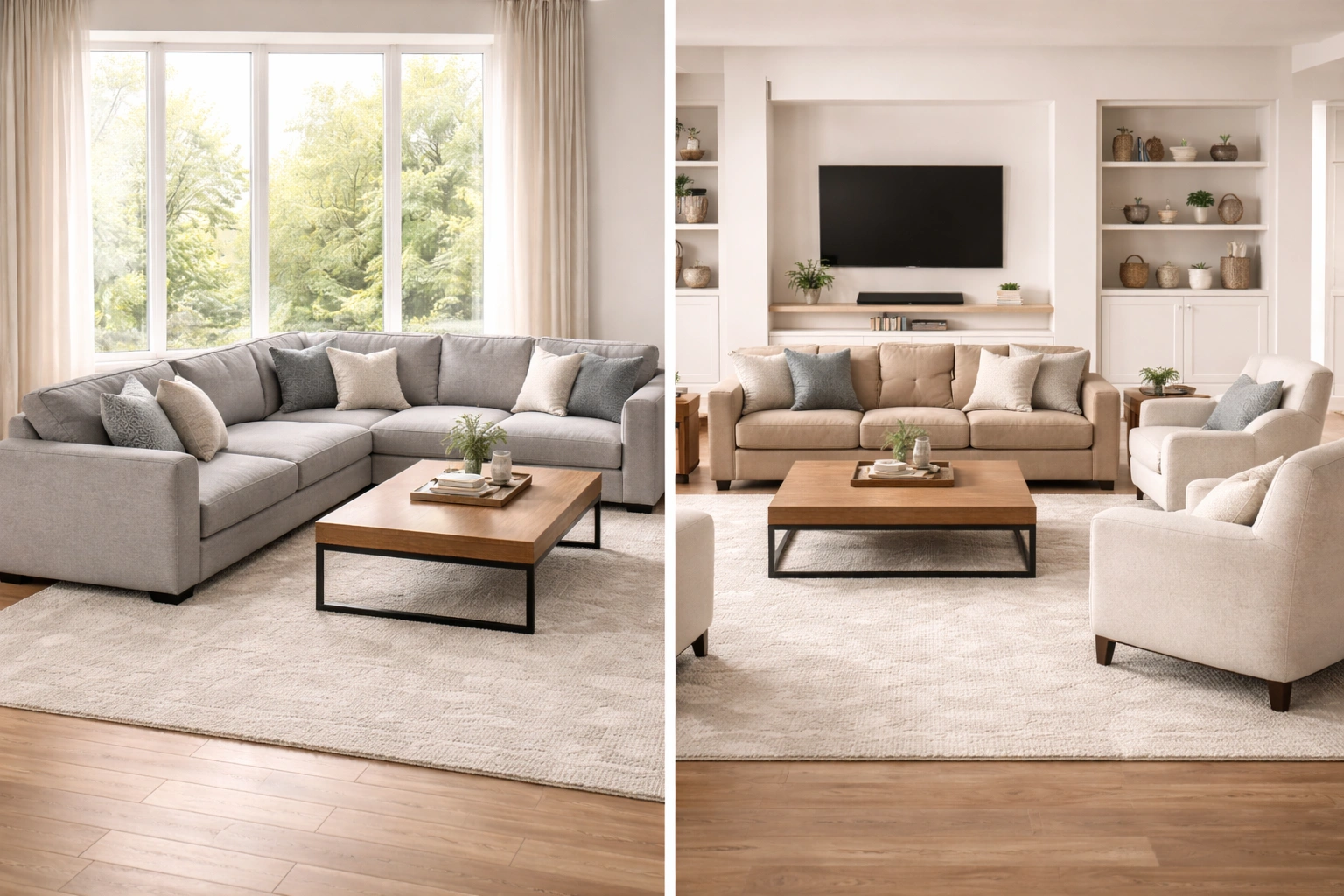
If you are deciding between a sectional and a conventional sofa-plus-chairs arrangement, this comparison highlights the practical differences that matter most in daily use.
| Factor | Sectional Sofa | Traditional Sofa + Chairs |
|---|---|---|
| Seating Capacity | 5–9 people in one unit | 3–4 on sofa + 1–2 per chair |
| Room Definition | Naturally zones open spaces | Requires rugs or furniture arrangement |
| Flexibility | Low — fixed configuration | High — pieces can move independently |
| Space Efficiency | Better per-seat in large rooms | Better in small or narrow rooms |
| Traffic Flow | Can block paths if poorly placed | Easier to maintain clear walkways |
| Delivery | Multiple heavy boxes | Single piece (easier) |
| Cost | $800–$6,000+ | $500–$3,000 (sofa only) |
| Best For | Large rooms, families, open plans | Small rooms, formal spaces, flexibility |
8. Room Placement Strategies
Where and how you place your sectional determines whether it elevates the room or overwhelms it. These strategies are derived from common interior design principles and real-world layout experience. For complete layout planning, see our living room layout guide.
Corner Anchor
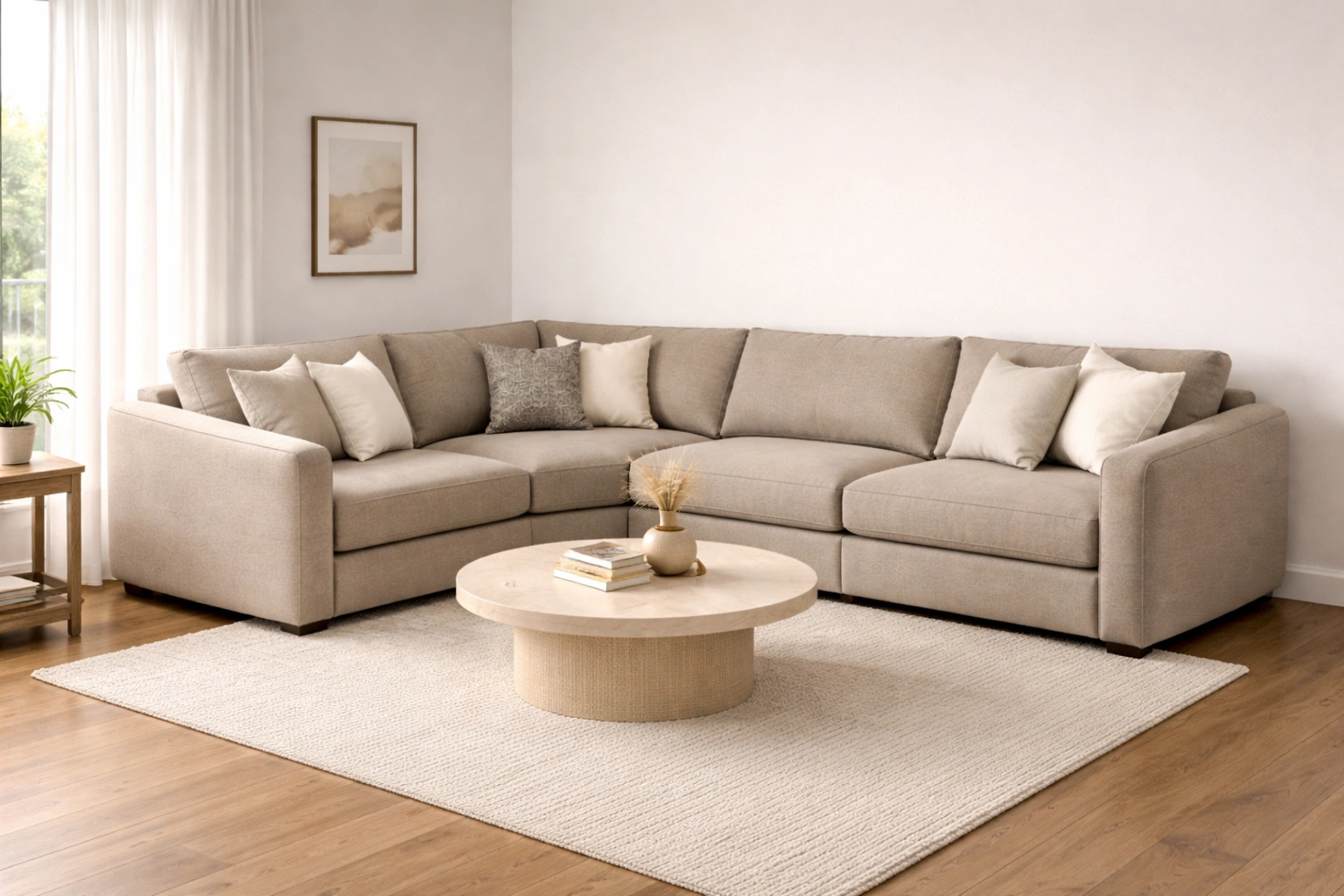
Place the sectional's corner piece into a room corner with both arms extending along walls. The most space-efficient placement — uses two walls as natural boundaries and opens the center of the room. Best for square and rectangular living rooms.

Floating Centerpiece
Position the sectional away from all walls, floating in the room to divide an open-concept space into distinct zones — living area behind, dining or entry in front. Requires the back of the sectional to be finished/upholstered. Best for large open plans (16×20+ ft).
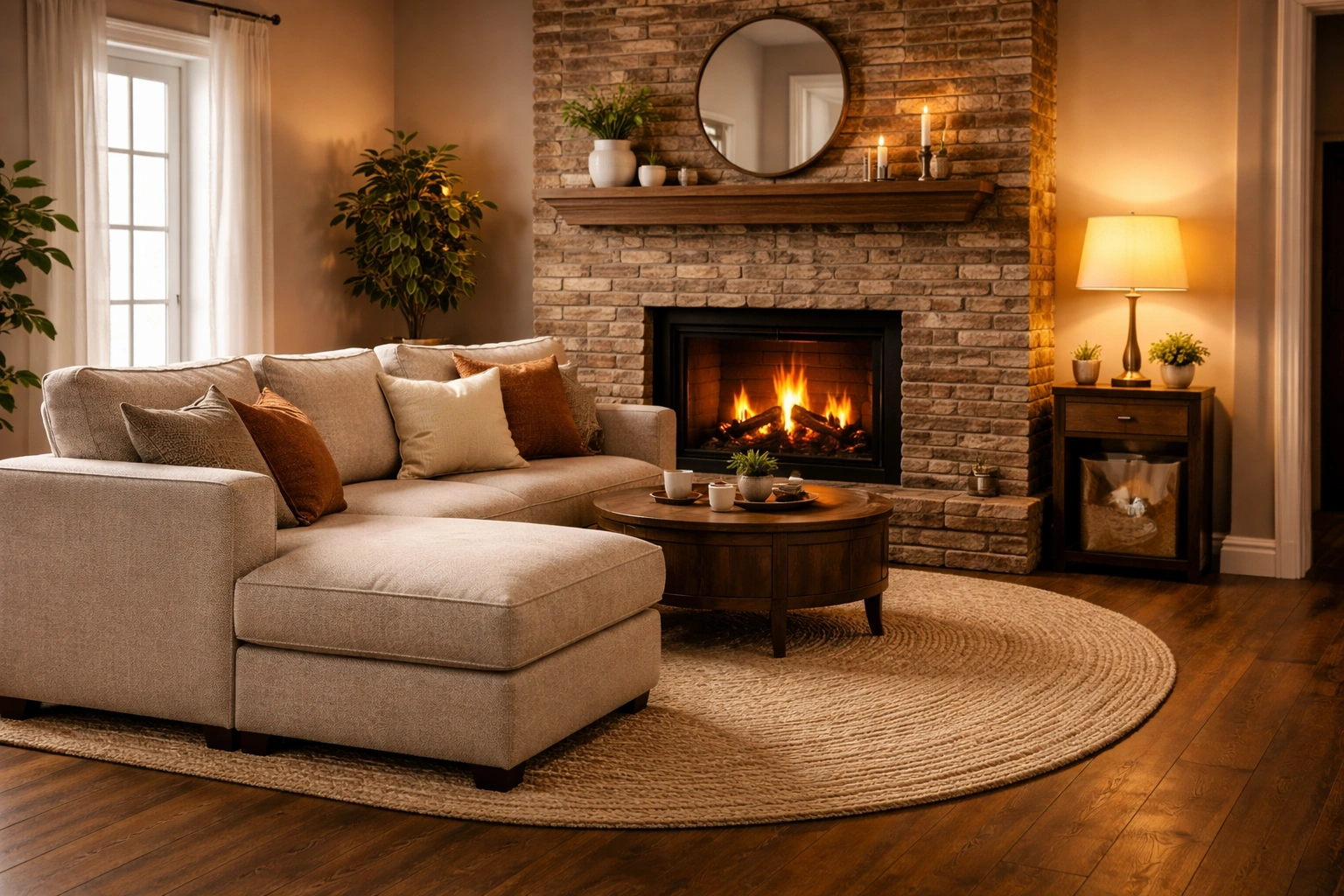
Facing the Focal Point
Orient the main seating section toward the room's focal point — fireplace, TV, or window view. The chaise extension then defines the secondary zone. The most common and intuitive placement for family rooms.
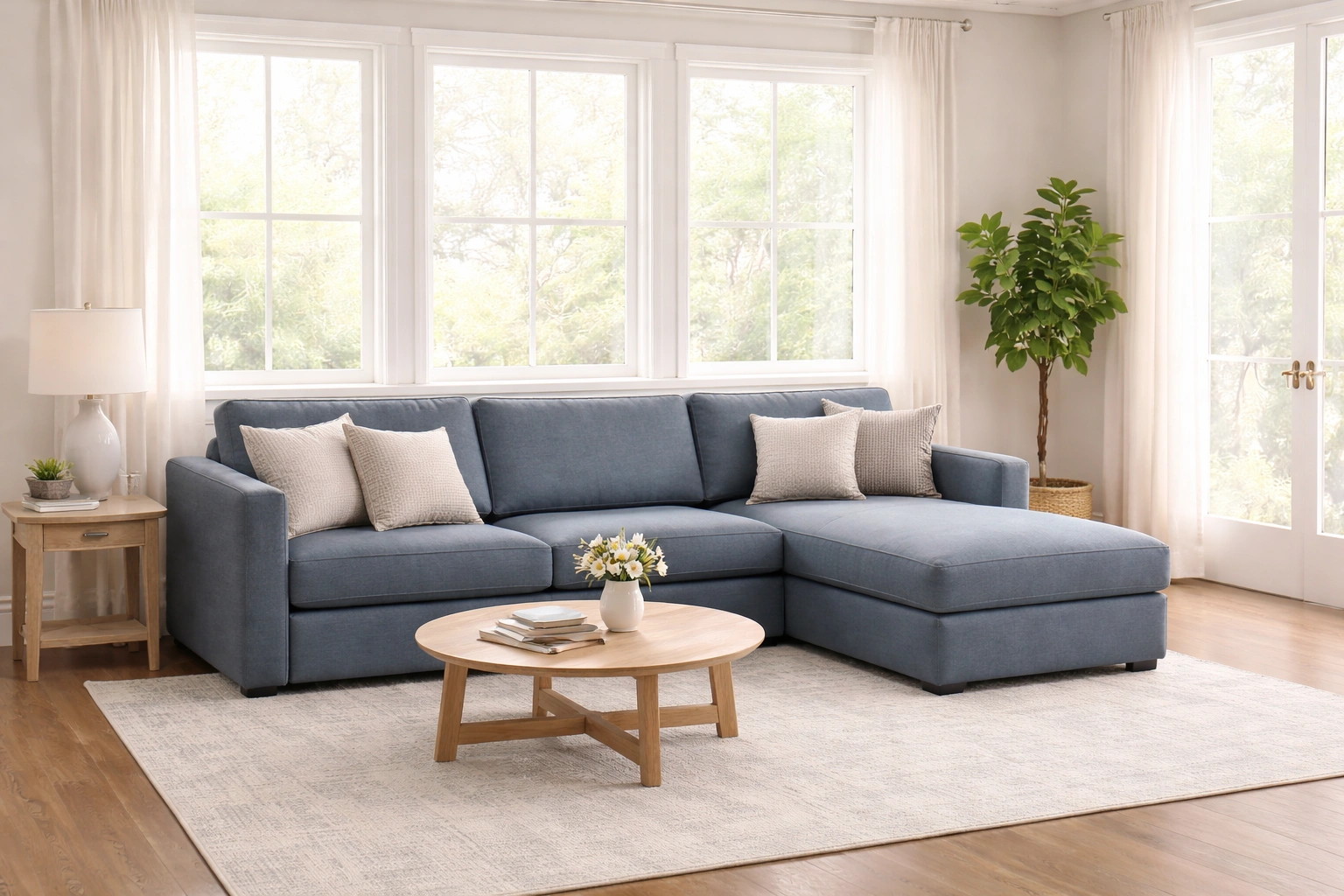
Below a Window Wall
Align the long section beneath a row of windows. Ensure the sectional back height does not block more than the bottom third of the glass. Works well in rooms with generous natural light. Avoid if windows extend to floor level.
Traffic Flow Rule: Maintain at least 36 inches of clearance for main walkways around the sectional, and 18–24 inches between the coffee table and the seating edge. If the sectional forces people to walk through the seating area (between the coffee table and sofa), the layout needs adjustment — either rotate the configuration or choose a smaller size. See what size sofa for my room for precise clearance calculations.
9. Maintenance & Care
Sectionals require the same material-specific care as any sofa, but their size and configuration create additional challenges — particularly at the junction points where sections connect. Here is a focused guide for sectional-specific maintenance.

Junction & Seam Care
Where sections connect, debris accumulates in the gap. Use a narrow crevice attachment on your vacuum weekly. For fabric sectionals, check that connector clips or brackets remain tight — loose connections cause sections to separate and create wider gaps that trap more debris.
Cushion Rotation
If cushions are removable, rotate and flip them every 2–3 months to ensure even wear. On a sectional, the seat nearest the main walkway typically wears fastest. If cushions become uneven, see our sagging cushion fix guide.
Fabric Cleaning
Vacuum the entire surface weekly using the upholstery attachment. Treat stains immediately — see stain removal techniques. For performance fabrics, most stains clean with water and mild soap. Apply fabric protection at purchase and reapply annually.
Frame & Leg Maintenance
Tighten legs and connector bolts quarterly — sectionals generate more stress at connection points than standard sofas due to their size. If the frame squeaks when sat on, check frame repair and spring replacement guides. Use felt pads under all legs to protect flooring.
Protection for High-Traffic Sectionals: If your sectional is in a family room with kids or pets, consider pet-proof covers for the most-used seats, or invest in a slipcovered sectional where the entire cover can be removed and machine-washed. This is often more practical than spot-cleaning a 100+ inch sofa. Adding throws and pillows on high-wear arm areas also extends the upholstery life significantly.
10. Buying Tips & Checklist
Buying a sectional is a significant investment — both financially and spatially. This checklist covers every evaluation point that separates a smart purchase from a costly mistake. For broader buying principles, see how to choose a sofa.

Sectional Sofa Buying Checklist
- Confirm LAF vs. RAF: Stand facing the intended wall and verify which side the chaise extension should be on. This cannot be changed after purchase on most fixed sectionals.
- Map the full footprint: Use painter's tape on the floor to outline the total width AND depth including the chaise. Leave 36-inch walkway clearance on all open sides.
- Verify doorways and staircases: Measure the narrowest point the delivery team must navigate. Individual sectional pieces are typically 35–45 inches wide and cannot be bent.
- Check connection hardware: Inspect the clips, brackets, or bolts that join sections. They should feel solid with no wobble. Weak connections cause sections to separate over time.
- Evaluate frame material: Kiln-dried hardwood (oak, ash, beech) is essential for a piece this large. Softwood frames will not hold up under the structural stress of a multi-piece sectional.
- Test cushion fill: High-density foam (2.0+ lb/ft³) wrapped in dacron provides the ideal balance. Sit on every section — comfort can vary across seats. Learn about cushion fill types.
- Verify spring system: Hand-tied eight-way springs offer the best support for large pieces. Sinuous springs are acceptable but may develop sagging faster in high-traffic seats.
- Check the back: If floating the sectional, confirm the back is fully upholstered — some sectionals have an unfinished back covered only by a dust cover.
- Assess fabric durability: For a sectional, aim for 30,000+ Martindale rub count minimum, 50,000+ for families. See the Martindale test explained.
- Understand delivery logistics: Sectionals ship in multiple boxes. Confirm white-glove delivery includes in-room placement and assembly — carrying 80-pound boxes up stairs is not a DIY task.
- Review the return policy: Many retailers charge restocking fees (15–25%) or do not accept returns on sectionals once assembled. Clarify this before ordering.
- Compare value, not just price: A $2,000 sectional with a hardwood frame and performance fabric offers better long-term value than a $1,500 one with a softwood frame and bonded leather. Read price vs. quality.
Budget Planning: Quality sectionals start at $800 for small fabric versions and range to $6,000+ for large leather sectionals with premium features. For a sectional that will last 10+ years in a family room, budget $1,500–$3,500. The sofa budget guide and price breakdown explain where your money goes. Also account for hidden costs like delivery fees ($100–$300), fabric protection ($50–$150), and a sofa table to fill the gap in a U-shape. Check the best time to buy a sofa for seasonal deals — sectionals are often discounted during Presidents' Day, July 4th, and Black Friday.
11. Frequently Asked Questions
Yes, but only with careful planning. An apartment sectional in the 70–85 inch range with a compact chaise can work in rooms as small as 9×9 ft if placed in a corner. Avoid U-shapes in apartments — they require too much floor space. A modular sectional is often a smarter apartment choice because you can start with 2 pieces and add more if you move to a larger space. See our small space sofa guide for specific recommendations.
LAF (Left-Arm Facing) means the chaise extension is on your left side when you face the sofa. RAF (Right-Arm Facing) means it is on your right. To determine which you need: stand in the room where the sectional will go, face the wall it will sit against, and note which side has more open space for the extension. This is a critical specification — ordering the wrong orientation means the sectional will not fit your room layout.
Sectionals separate when connection hardware fails or was inadequate from the start. Ensure all clips, brackets, or bolts are properly engaged during assembly. If your sectional uses metal L-brackets, check that screws are tight quarterly. For sectionals that rely on gravity or velcro connections, consider adding aftermarket connector clips for a more secure join. If sections still separate despite tight hardware, the floor may be uneven — use furniture leveling glides on the legs. See our loose leg repair guide.
It depends on your primary use. If the room is mainly for watching TV, orient the main seating toward the screen. If the fireplace is the focal point and you want a more conversational atmosphere, face the fireplace. In open-concept spaces, you can compromise by placing the sectional perpendicular to both — the main section faces one focal point while the chaise side faces the other. See living room layout guide for diagrams.
Slightly, due to the larger surface area and the junction points where sections meet. Debris accumulates in the gaps between pieces, requiring a crevice tool for thorough vacuuming. The back of a floating sectional can also be hard to reach. However, the actual cleaning process per square foot is the same as any sofa — see fabric cleaning or leather cleaning guides. Choosing a washable sofa with removable covers eliminates most of the difficulty.
A quality sectional that will last 10+ years costs $1,200–$3,500 for fabric and $2,000–$5,000+ for leather. Small apartment sectionals start around $600–$800. Budget sectionals under $700 often use softwood frames and low-density foam that will show wear within 2–3 years. Large U-shape sectionals with premium features (reclining, power, leather) can reach $4,000–$8,000+. See how much a good sofa costs and explore budget sofa options.
Only if you purchased a modular sectional or a brand that sells compatible add-on pieces. Most fixed sectionals cannot be extended — the connection hardware and frame geometry are specific to that configuration. If future flexibility is important, choose a modular sectional from the start, or buy from brands that offer individual section pieces in matching fabrics. Confirm fabric dye lot compatibility if adding pieces later — even the same fabric can look different between production runs.